Do You Really Need an 88-Key Keyboard? The Truth for Beginners
SEO Excerpt: Starting piano doesn't have to break the bank or take up your whole living room. Discover why an 88-key keyboard might actually be overkill for beginners and learn the "sweet spot" for your child’s first instrument in our expert guide.
![[HERO] Do You Really Need an 88-Key Keyboard? The Truth for Beginners](https://ipianolab.s3.us-west-2.amazonaws.com/blog/posts/25/assets/marblism/cdn.marblism.com/eL1bL8lOcKU.webp)
So, you’ve finally decided to bring the gift of music into your home. That is amazing! Whether you’re signing up your child for after-school classes or you’re looking to learn piano at home yourself, the very first hurdle usually involves a trip to the music store (or a late-night Amazon scroll).
Then the panic sets in. You see these massive, 88-key weighted digital pianos that cost as much as a used car and take up half the hallway. Then you see the smaller, 61-key "portable" keyboards that look much more manageable for a beginner.
You start wondering: "If I buy the smaller one, am I setting my child up for failure? Will they run out of keys in three weeks?"
The good news is: No, you do not absolutely need an 88-key keyboard to start. In fact, for many families, starting smaller is actually the smarter move. Let’s break down the truth about keyboard sizes so you can make a low-stress, high-value decision.
The "Full-Size" Myth
When people say "piano," they almost always picture the standard 88-key instrument. It’s been the standard for over a century. However, here is a little secret from the world of music education: most beginners won’t touch those extra keys for at least two years.
Think about it like learning to drive. You don’t need a 500-horsepower racing engine to learn how to parallel park and navigate a neighborhood. You need something reliable, sized appropriately, and easy to handle.
Research actually shows that 94% of beginner repertoire fits within just 36 keys. That’s less than half of a full piano! Most of the songs your child will play in their first year, and even their second, live right in the middle of the keyboard. Those very high and very low notes are mostly there for advanced classical pieces by Liszt or Rachmaninoff. Unless your six-year-old is planning to drop a heavy Russian concerto next Tuesday, those extra keys are just taking up space.
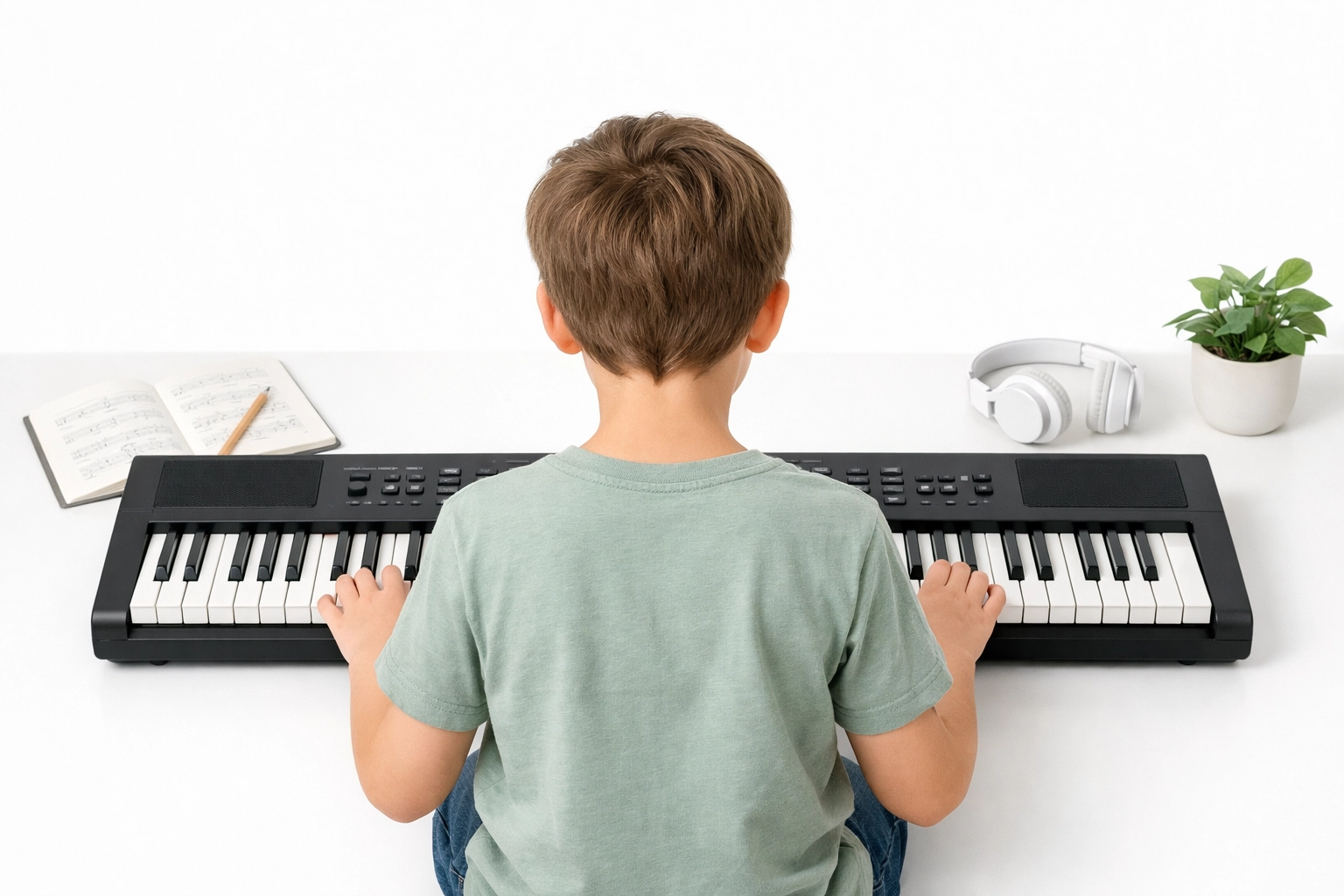 A young student practicing comfortably on a portable keyboard, focusing on the middle octaves where the music happens.
61 Key vs 88 Key Keyboard: Finding the Sweet Spot
If 88 is the "pro" level and 25 is a "toy," where is the "just right" Goldilocks zone for a beginner?
For most of our students at iPianoLab, we recommend a 61-key keyboard.
Why 61? It gives you five full octaves. This is more than enough range to play with both hands, learn all your chords, and tackle almost any pop song, movie theme, or beginner classical piece.
Here are a few reasons why smaller is often better for families:
- Portability: A 61-key keyboard can be tucked under a bed, put in a closet, or moved from the living room to the bedroom with one hand.
- Cost: You can get a high-quality beginner keyboard for a fraction of the price of a full digital piano. This makes the "buy-in" much lower while you see if your child really sticks with it.
- Less Intimidating: For a small child, an 88-key piano looks like a giant machine. A 61-key keyboard feels like a tool they can master.
It’s all about reducing the barriers to entry. We want the keyboard to be out and available, not a heavy piece of furniture that stays covered because it’s too hard to move.
What About "Weighted" Keys?
This is where the keyboard buying guide gets a little technical, but I'll keep it simple. Acoustic pianos have "weighted" keys because of the hammers inside. Many 88-key digital pianos mimic this feeling.
Is it better? For technique, yes, eventually. Is it necessary for a first-grader? No.
In fact, "unweighted" or "synth-action" keys are much easier on small hands. It takes less finger strength to produce a sound, which means less frustration during those first few months of practice. OK, if you end up becoming a professional concert pianist, you’ll definitely need weighted keys. But for now? Focus on the fun.
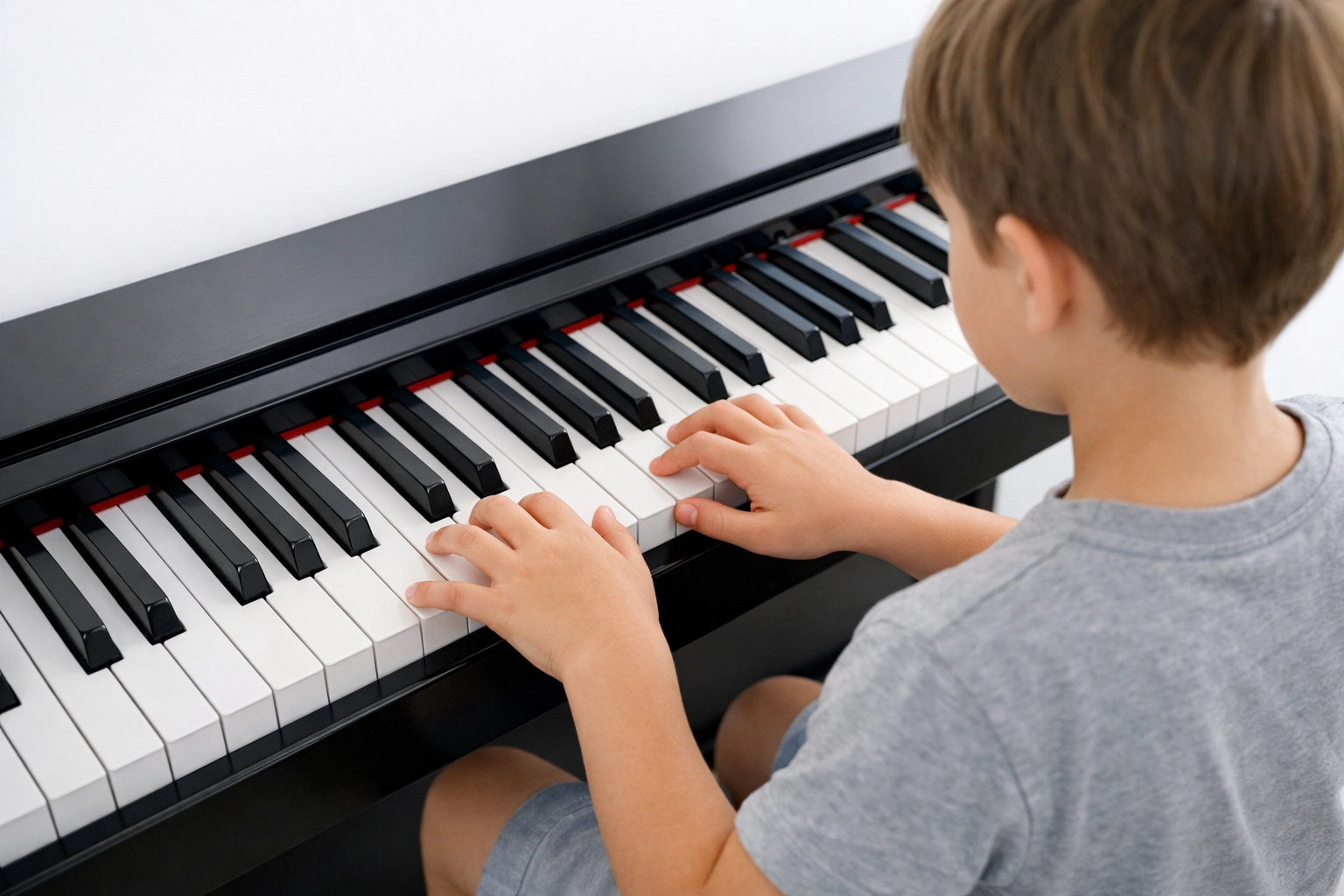 Close-up of a student’s hands on a keyboard, showing the proper hand position for beginner songs.
The iPianoLab "Song-First" Method
The reason we aren't obsessed with having 88 keys right away is because of how we teach. At iPianoLab, we use our proprietary "Song-First" method.
Traditional lessons often start with months of dry scales and finger exercises that span the whole keyboard. Boring! We get kids playing the songs they actually love: hits from the radio, movie themes, and video game music: from the very first lesson.
Because we focus on modern music and foundational chords, a 61-key keyboard is perfectly suited for our curriculum. We want your child to feel the win of playing a recognizable tune immediately. Once they are hooked on the feeling of making music, then we can talk about upgrading to a bigger instrument down the road.
Speaking of growth, we have some big news! To better reflect how our students "take flight" with their music, iPianoLab is transitioning to our new name, PianoFlight, this summer! It’s the same great teachers and the same fun method, just with a fresh new look as we expand our programs.
Where to Practice?
Sometimes, the "keyboard at home" situation isn't just about the number of keys: it's about the environment. If you're looking for a professional space to really dive deep into music, or perhaps you're a teacher looking for the perfect spot to host a rehearsal, we always recommend checking out Lenox Hill Music Studios. They provide top-tier spaces that inspire creativity, which is exactly what we’re all about.
Practical Tips for Your Keyboard Search
If you’re ready to start shopping, here is a quick checklist to keep in mind:
- Look for "Full-Size" Keys: Even if the keyboard only has 61 keys, make sure the keys themselves are the same size as a real piano's. Avoid the "mini-keys" usually found on toddler toys.
- Touch Sensitivity: If your budget allows, look for "touch-sensitive" or "velocity-sensitive" keys. This means if you hit the key harder, it sounds louder. It’s the most important "pro" feature for a beginner.
- A Solid Stand: Don't just put the keyboard on a kitchen table. It’ll be too high, and your child’s posture will suffer. A simple "X-style" stand is cheap and keeps the keyboard at the right height.
- The Tablet Factor: At iPianoLab, we love using technology. Make sure your keyboard setup has room for a music stand or a place to prop up a tablet so your child can follow along with our online lesson videos and games.
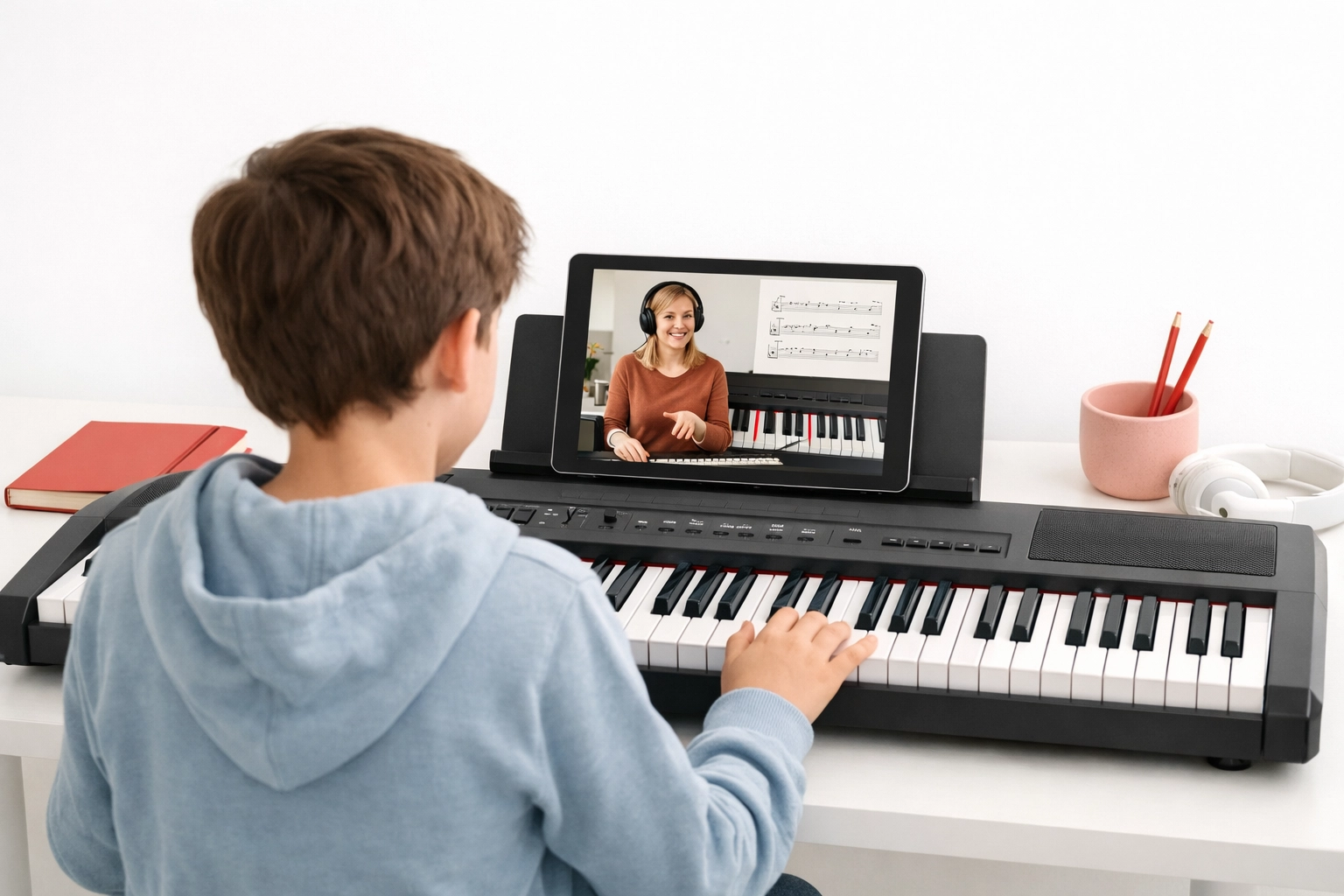 A student following a video lesson on a tablet placed directly on the keyboard stand, making practice feel like a fun game.
Don't Let the "Perfect" Instrument Stop You
The most important thing to remember is that the best keyboard is the one that gets played.
If you spend three months researching the "perfect" 88-key weighted digital piano, that’s three months your child could have been spent learning their first three songs on a $100 portable keyboard.
Think of a 61-key keyboard as a low-risk investment in your child's brain and happiness. If they outgrow it in two years? That’s a success story! It means they’ve practiced so much and progressed so far that they actually need the extra octaves. That is the best problem to have.
Need More Help?
We know that choosing an instrument can still feel a bit overwhelming. That’s why we created a comprehensive, free keyboard buyers guide to help you navigate the brands and models we trust. You can even download the guide directly to take with you to the store!
Whether you’re looking for online lessons or want to find one of our after-school programs in NYC or beyond, we are here to help your child start their musical journey.
Don't overthink the 88 keys. Get a solid 61-key keyboard, clear some space, and let the music start. No question about it: you’ve got this!
Ready to get started? Sign up today and let’s get playing!