How to Make Piano Practice Fun: 5 Games for Elementary Students
![[HERO] How to Make Piano Practice Fun: 5 Games for Elementary Students](https://ipianolab.s3.us-west-2.amazonaws.com/blog/posts/16/assets/marblism/cdn.marblism.com/-xy1fn1NX3s.webp) Is "practice time" the most stressful part of your day? If you’re nodding your head, you aren't alone. For many parents, getting a child to sit down at the keys feels like a constant uphill battle. You know they love music, and you know they enjoy their beginner piano lessons, but the actual act of repeating scales and songs can feel, well, a little boring for a seven-year-old.
Is "practice time" the most stressful part of your day? If you’re nodding your head, you aren't alone. For many parents, getting a child to sit down at the keys feels like a constant uphill battle. You know they love music, and you know they enjoy their beginner piano lessons, but the actual act of repeating scales and songs can feel, well, a little boring for a seven-year-old.
The good news is that it doesn't have to be this way! At iPianoLab, we believe that if a child is having fun, they are learning. We are currently transitioning our brand to Piano Flight, which represents the future of music education, a world where learning piano is as engaging as playing a video game or a sport. Piano Flight is all about taking the "work" out of "homework."
If you want to learn piano at home without the nagging, the secret is to gamify the experience. By turning technical drills into interactive challenges, you help your child build muscle memory and ear training without them even realizing they’re "practicing."
Here are five simple, high-energy games you can play with your elementary student today to make piano practice tips actually stick.
1. The Rhythm Echo (Copy My Rhythm)
One of the foundational skills in music is rhythm. Before a child can play a complex piece, they need to feel the beat in their bones. This game is a fantastic way to warm up away from the keys or right on the bench.
How to play:
Start by sitting across from your child. You clap a simple one-bar rhythm (think: clap, clap, clap-clap, clap). Your child has to "echo" it back to you perfectly. As they get better, make the rhythms more complex.
Take it to the piano:
Once they’ve mastered clapping, move to the keyboard. Pick one note, maybe middle C, and have them play the rhythm back to you using that single key. This links their auditory input (hearing the rhythm) to their motor output (hitting the key). It’s a great way to start any session.
If you find that your child responds well to this type of structured but short burst of activity, you might want to check out our 15-minute daily piano practice plan for more ideas on keeping sessions brief and effective.
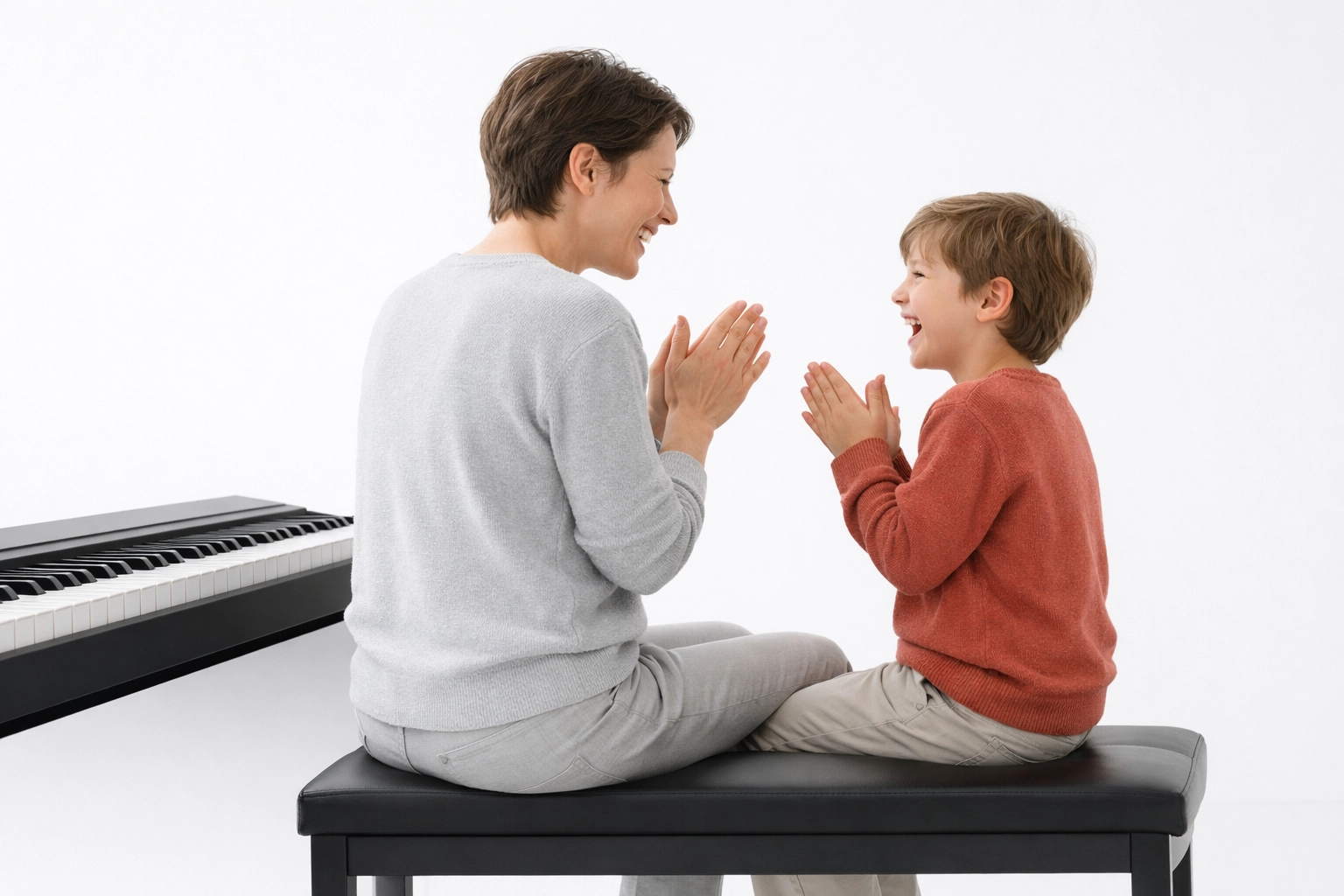
A student and parent laughing while clapping together at a piano, focusing on rhythm.
2. Musical Statues (Play My Moves)
Elementary students have a lot of energy. Sometimes, forcing them to sit still on a bench for 30 minutes is the quickest way to cause a meltdown. This game incorporates kinesthetic learning, connecting physical body movement to musical pitch.
How to play:
Assign three different pitches to three different movements. For example:
- High C: Stand up tall with hands in the air.
- Middle G: Sit normally on the bench.
- Low C: Crouch down to the floor.
You play one of those notes, and your child has to move to the corresponding position as fast as they can. Then, swap roles! Let them play the notes while you do the movements. They will love "controlling" you, and it forces them to identify the different registers of the piano.
This type of "active" learning is exactly what we specialize in at our NYC classes. If you're in the area and looking for a social environment, we often recommend checking out the rehearsal spaces at Lenox Hill Music Studios for a professional atmosphere that still feels like a community.
3. The Great Keyboard Card Race
Note identification can be one of the most tedious parts of piano lessons for kids. Flashcards are okay, but a "race" is much better.
How to play:
Create a small stack of cards with the music alphabet letters (A, B, C, D, E, F, G). Place the cards on one end of the keyboard. You stand at the other end.
Your child draws a card and has to find that note on the keyboard. But here’s the catch: they have to find the nearest version of that note to where you are standing. Then it’s your turn. The goal is to "race" across the keyboard using the notes drawn from the deck.
Pro-Tip: Make sure your child is looking for the patterns of the black keys (the groups of 2 and 3) to find their notes. This is a crucial skill for beginners. If you're still in the process of getting set up at home, our keyboard buyers guide can help you find a model that has the right feel for these kinds of games.
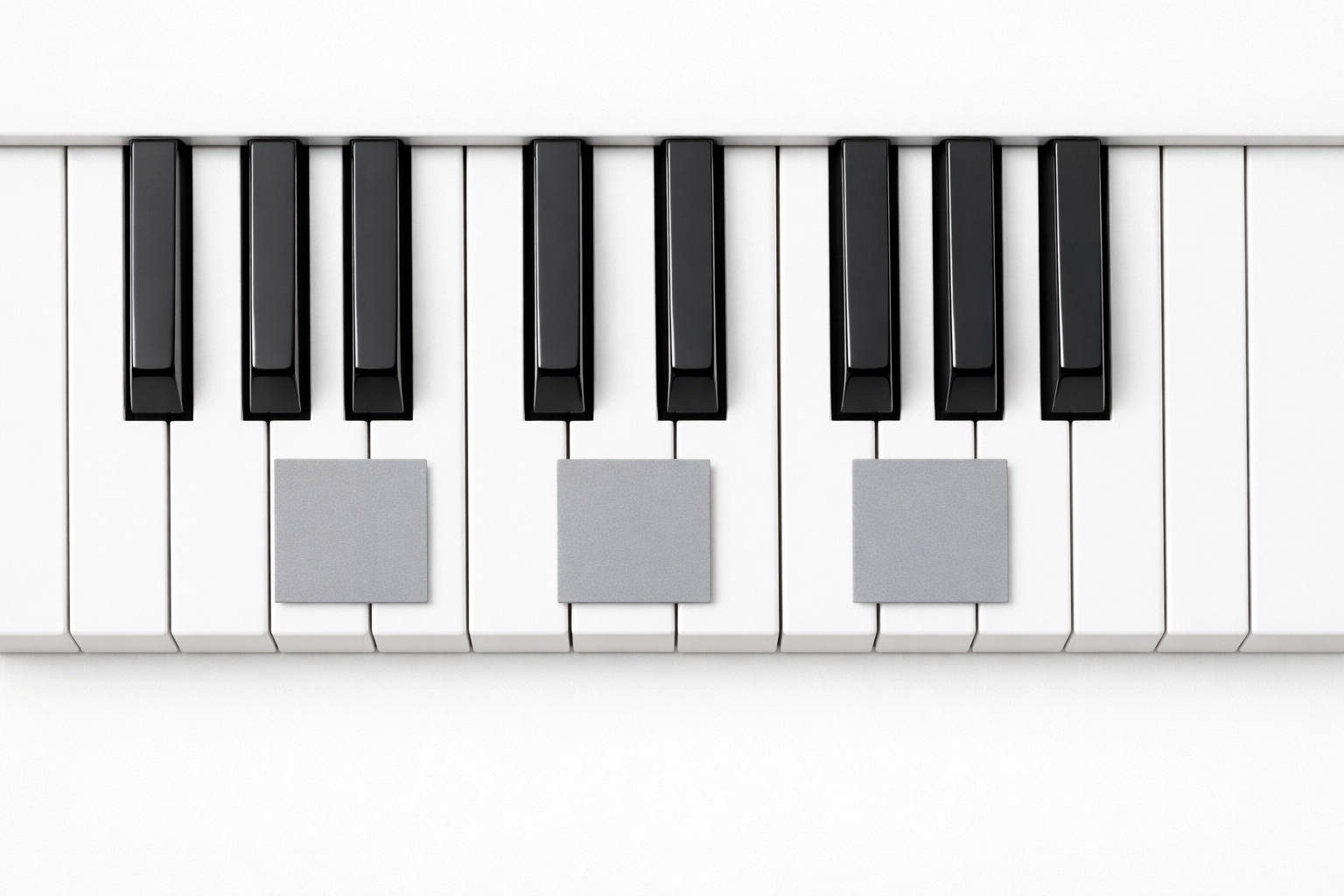
Close up of a keyboard showing the clear pattern of two and three black keys, with cards placed on the white keys.
4. The "Mystery Melody" (Copy My Phrase)
This game builds aural training, which is the ability to hear a melody and understand how to recreate it. It’s essentially "hide and seek" for the ears.
How to play:
Have your child look away or close their eyes. Play a very simple three-note phrase (like C - D - E). Now, ask them to find those "mystery notes" on the piano.
Start very simply with notes that are right next to each other. As they get more confident, you can introduce small jumps (like C to E). It’s okay if they guess wrong at first! The "game" is in the discovery. This builds a massive amount of confidence because it proves to the child that they can figure out music on their own, without always needing a sheet of paper in front of them.
5. Finger Twister
Developing finger independence is tough for small hands. "Finger Twister" makes the physical exercise of finger placement feel like a challenge rather than a chore.
How to play:
You can use a simple spinner or just call out instructions. Assign a number to each finger (1 for thumb, 5 for pinky). Call out a finger and a note, for example, "Finger 3 on E!" then "Finger 1 on C!"
The goal is to see how many fingers they can "stick" to the keys in the correct positions before their hand "crashes." It’s a great way to practice the "claw" hand shape that teachers are always talking about.
This game is especially popular in our group settings. If you’ve ever wondered if your child would do better with peers, take a look at our article on group vs. private piano lessons. Sometimes having a "competitor" in a game makes all the difference!
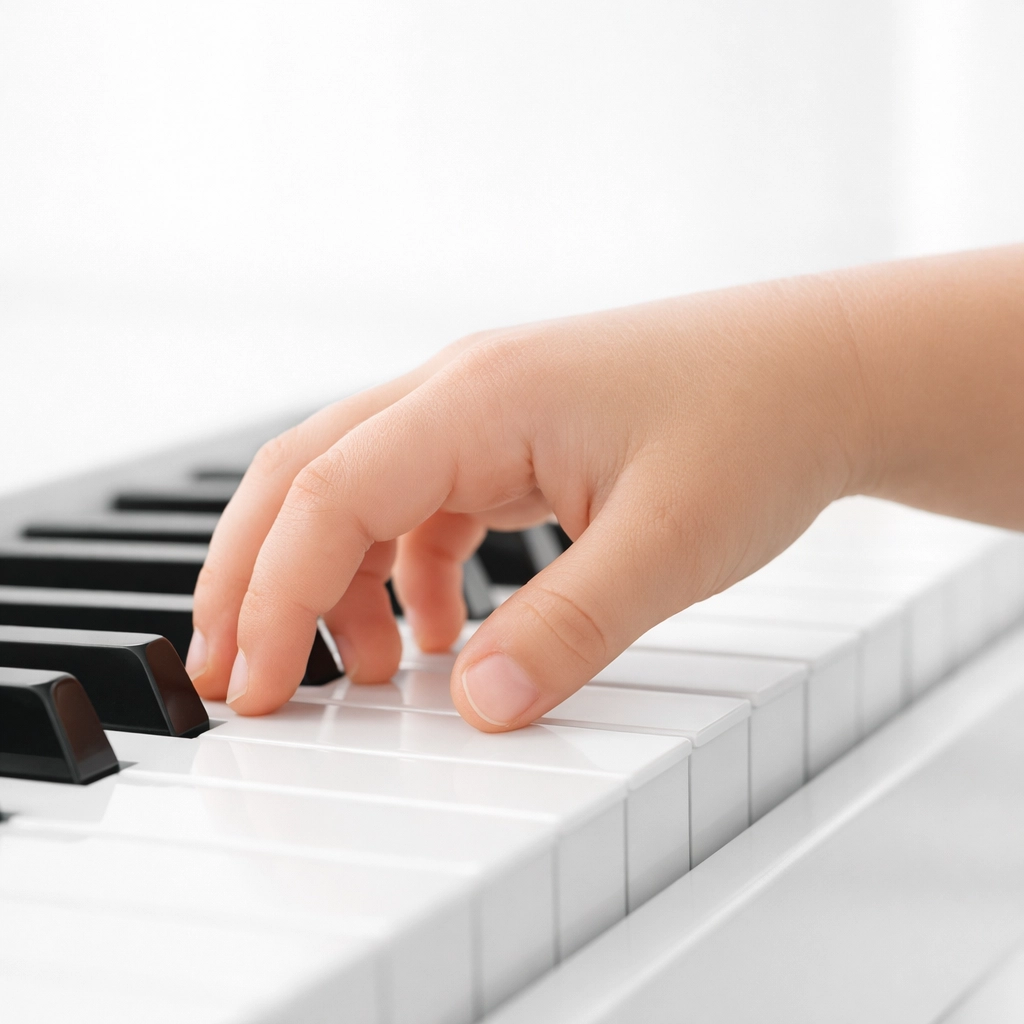
A child’s hand in a proper curved 'bridge' shape on the piano keys, demonstrating finger independence.
Why This Works
You might be thinking, "This is great, but are they actually learning to play songs?"
The answer is a resounding yes.
When a child plays these games, they are building the "pre-skills" required for mastery. They are learning:
- Pitch Recognition: Distinguishing between high and low sounds.
- Rhythm: Internalizing the beat.
- Keyboard Topography: Navigating the black and white keys quickly.
- Finger Strength: Building the muscles needed for more complex pieces.
At iPianoLab, soon to be Piano Flight, our method is built on this foundation. We don't believe in boring drills. We believe in getting kids to play the music they love, whether that's Taylor Swift, Star Wars, or Minecraft themes, as quickly as possible. These games are the bridge that gets them there.
Making the Most of Your Practice Time
The key to keeping piano practice tips effective is consistency, not duration. Ten minutes of playing games is much more valuable than thirty minutes of tearful scale practice.
If you’re just starting your journey and wondering if your child is ready, check out our guide: Is your child too young for piano lessons?. Most of the time, if they can play these games, they’re ready to start!
As we move toward the summer of 2026, keep an eye out for the Piano Flight name. It’s the same team, the same teachers, and the same fun philosophy you’ve come to love at iPianoLab, just with a new look that matches our mission to make music education the most exciting part of a child's week.
OK, enough reading: go grab some letter cards and head to the piano. It’s game time!
Ready to take the next step?
Whether you’re looking for online piano lessons or want to join us in person, we’re here to help your child find their musical wings. The future of music education is here, and it's powered by Piano Flight.