Why Does My Child Keep Looking at Their Hands While Playing Piano?
Quick answer: it is normal for a beginner pianist to look at their hands sometimes. Children look down to find a starting note, check a hand move, or confirm where their fingers landed. The goal is not to ban looking at the keys. It is to help the child look down with a purpose, then return their eyes to the music without losing their place.
If your child can play a short spot but stops whenever their eyes move back to the page, the challenge may be eye–hand coordination rather than note knowledge. A calm five-minute look–touch–return routine can build keyboard awareness one tiny movement at a time. Keep the teacher’s assigned notes and fingering, and never force the child to play without looking.
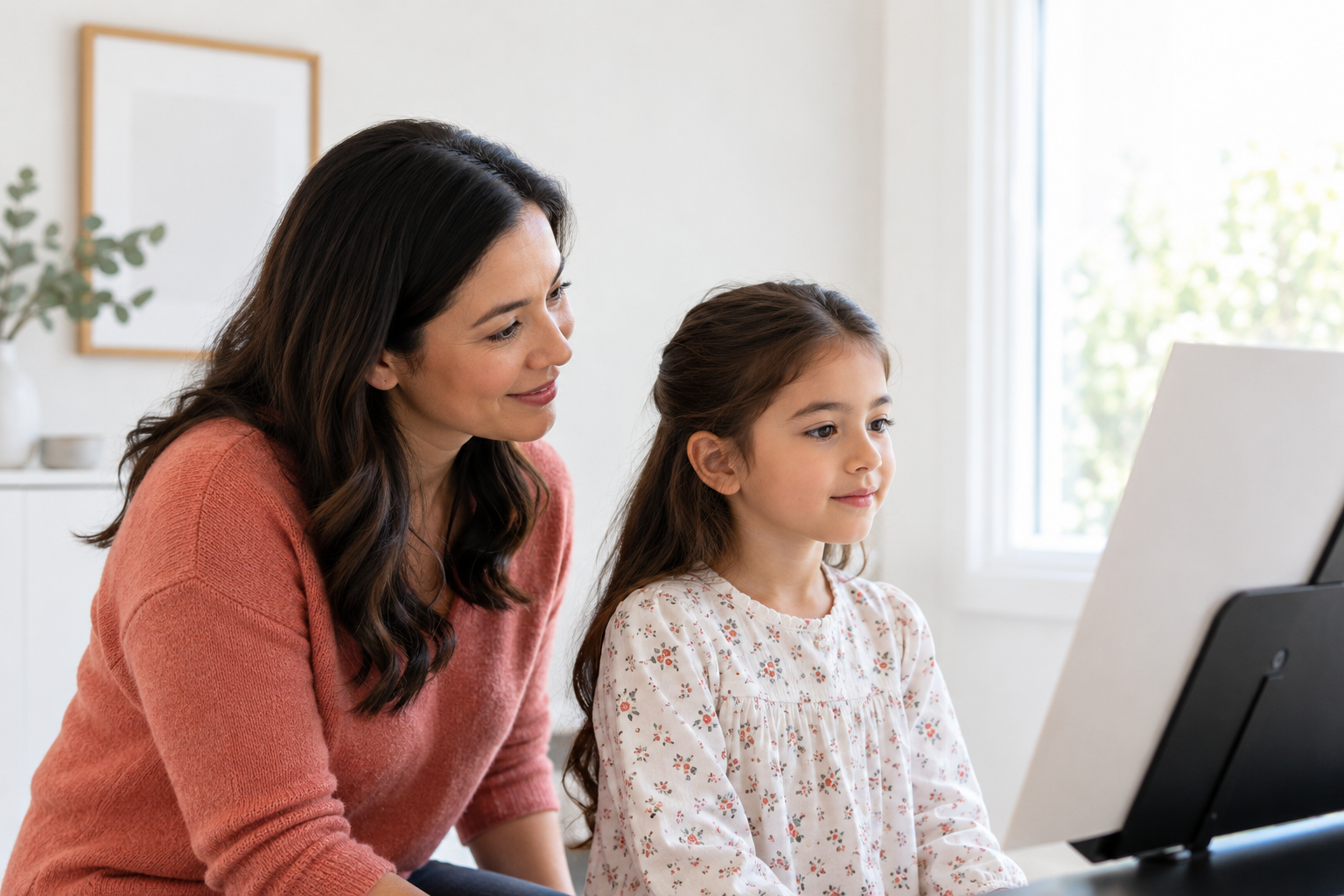
Is it normal for a beginner pianist to look at their hands?
Yes. Even experienced pianists look at their hands for some leaps, position changes, chords, or technical passages. A young beginner has an extra reason: the keyboard is still a new map. The repeating groups of black keys, the distance between notes, and the feeling of each hand position are not yet automatic.
Problems appear only when every note requires a visual check. Constantly moving the eyes between page and keys can make a child lose the beat, forget the next note, or restart the same measure. That does not mean the child is lazy or “bad at reading.” It means several skills are competing for attention at once.
| What you notice | What it may mean | Helpful next step |
|---|---|---|
| One quick glance before starting | The child is checking a starting position | Let them set the hand, then return to the page |
| Eyes drop before one larger move | The distance is not yet familiar | Practice only the note before and after the move |
| Eyes bounce on every note | The spot may be too long, fast, or unfamiliar | Shrink it to two or three notes and slow down |
| The child cannot find the place on the page again | The return trip is the hard part | Mark one visual anchor and practice returning to it |
Why does my child keep looking down at the piano keys?
Several beginner tasks can cause the same visible habit. Before correcting the eyes, identify the job the child is trying to complete.
The starting position is uncertain
A child may know the note name on the page but still need time to locate the matching place on the keyboard. Ask the child to find the starting note before the count-in, then let the eyes return to the music. This separates setup from playing.
The hand has to move to a new position
A shift, skip, or wider interval can feel risky. One planned glance may be exactly what the child needs. Practice the move by itself instead of demanding an entire line with eyes fixed on the page.
The music is not yet visually familiar
If the child is decoding every symbol slowly, looking down provides temporary reassurance. Reduce the reading load: choose one measure, point out repeated notes or stepwise motion, and ask what stays the same before playing.
The child has memorized the fingers instead of the page
Some beginners remember a hand pattern and use the keys as the main cue. That can help them play an early song, but it becomes limiting if they cannot connect the pattern back to written music. Alternate one short eyes-on-page repetition with one memory repetition so both skills have a place.
The tempo is too fast
At a rushed speed, the eyes and hands do not have time to share information. Slowing down is not a punishment. It creates enough space to look ahead, move, and return to the score before the next decision.
What should parents watch and listen for?
Do not measure success by how long the child stares at the page. Listen for whether the musical line survives the glance.
- Starting accuracy: can the child place the hands before the music begins?
- Steady pulse: does one glance create an extra pause?
- Page return: can the child find the next note or measure after looking down?
- Comfort: are the shoulders, wrists, and hands relaxed while attention shifts?
- Recovery: after a mistake, can the child restart from a nearby landmark instead of returning to the beginning?
If the child repeatedly loses the place after looking down, pair this guide with the iPianoLab routine for helping a beginner find and keep their place in piano music. If the eyes move because the child is correcting repeated note errors, use the separate wrong-notes parent guide to identify the pattern first.
A five-minute look–touch–return routine
Use one two- to four-note spot from the child’s current assignment. Choose a passage with no large leap at first. The goal is one calm return to the page, not a full piece played without looking.
- Prepare for one minute. Ask the child to point to the starting place in the music, then find the starting notes on the keyboard. Let them look as long as needed before the count-in.
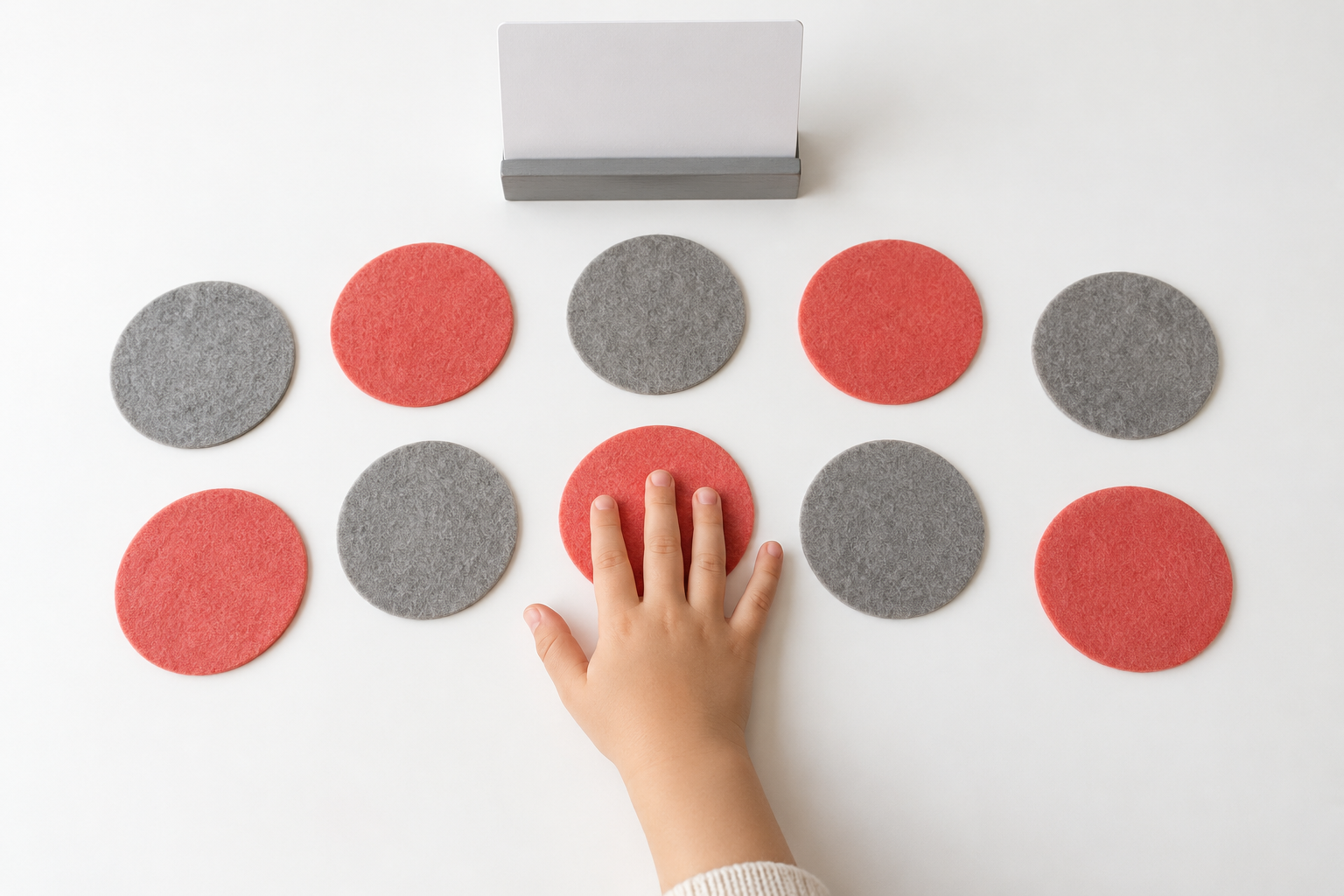
- Touch and return for one minute. Away from the keyboard, place five felt markers on a table. The child looks at a blank card ahead, touches the center marker, and returns the hand to a resting spot. Keep the movement small and comfortable.
- Use two familiar notes for one minute. At the piano, the child looks down to set the hand, returns to the page, and plays two notes slowly. Stop before attention becomes scattered.
- Add one planned glance for one minute. If the next note requires a move, decide exactly where the child may look down. After the move, pause and find the same place on the page again.
- Reconnect the phrase for one minute. Start one note before the practice spot and finish one note after it. Celebrate a steady return to the page, even if the notes are not perfect.
If two notes work but four do not, keep the smaller version. The child is learning a coordination loop: see the musical cue, prepare the movement, feel the keyboard, and return attention to what comes next.
Should a child ever practice without looking at the keys?
Only in a very small, safe, teacher-supported way. A child might repeat one familiar hand position, touch a nearby note, or play a two-note pattern while looking at the page. The activity should use comfortable notes and no sudden jumps.
Do not cover the child’s hands, blindfold them, turn off the lights, or insist on a complete song with eyes fixed forward. Those challenges can create tension or make a simple coordination problem feel like a test. A planned glance is better than guessing.
What should parents avoid saying?
Try not to repeat “Don’t look down” after every note. The instruction tells the child what to stop doing but not what to do next. Use one specific cue instead:
- “Find your starting notes, then bring your eyes back to measure two.”
- “Which note can be your page anchor after the move?”
- “Let’s play only the two notes around the glance.”
- “Did the beat keep moving when your eyes returned?”
- “Show your teacher the exact spot where the move feels uncertain.”
Avoid physically moving the child’s head or hands. Do not change fingering, hand position, or technique to solve the visual habit unless the teacher has asked for that change.
When should the piano teacher take the lead?
Ask the teacher when the child loses the place in nearly every measure, cannot find starting notes without repeated help, uses a different fingering each time, struggles with a particular leap, or becomes tense and upset when asked to look at the music. Bring one exact measure so the teacher can separate a reading problem from a movement, fingering, vision, or attention issue.
If the child has difficulty seeing the page, reports headaches or eye strain, or moves unusually close to the music, tell the appropriate adult and seek suitable professional guidance. A piano practice trick is not a substitute for a vision or health evaluation.
Why this skill matters for beginner piano students
Keyboard awareness helps a child keep reading while the hands perform familiar movements. It supports smoother rhythm, faster recovery, and more independent learning, but it develops gradually. The useful goal is flexibility: eyes on the music when reading matters, a purposeful glance when a move requires it, and a confident return to the next musical cue.
iPianoLab helps beginners connect enjoyable songs with keyboard geography, rhythm, counting, note reading, listening, two-hand coordination, and music literacy. That combination gives children more than one way to understand what they are playing.
Build reading confidence one small musical step at a time
Choose a beginner path that connects the page, the sound, and the keyboard through short songs, clear routines, and supportive teacher guidance.
Explore iPianoLab online piano learning, or choose an iPianoLab program for your child.
Frequently asked questions
Is it bad to look at your hands while playing piano?
No. Pianists look at their hands when a movement needs visual guidance. The problem is only constant checking that interrupts reading, rhythm, or confidence. Beginners can learn to use brief planned glances and return to the music.
Should beginner pianists look at the keys or the sheet music?
They may need both. Look at the keys to prepare a starting position or guide a move, and look at the music to follow notes, rhythm, and what comes next. The balance changes as keyboard awareness grows.
How can my child stop looking down at every piano note?
Shrink the music to two or three familiar notes, set the hand before playing, choose one page anchor, and practice one return from keys to page. Do not demand a whole song without looking.
Why does my child lose their place when looking back at the music?
The eyes may not have a clear return point. Mark one measure, line, or repeated pattern as an anchor and practice the eye movement separately from a long performance.
Does playing without looking improve sight-reading?
Small eyes-on-page exercises can support sight-reading, but sight-reading also requires rhythm, pattern recognition, note reading, and looking ahead. Avoid turning no-looking into a rule or test.
When should I ask the piano teacher for help?
Ask when the habit causes repeated pauses, wrong notes, tension, lost places, or frustration. Show the teacher one exact spot so they can check the reading level, fingering, hand move, and practice pace.