How Long Does It Take a Child to Learn a Piano Song?
Quick answer: a short, level-appropriate beginner piano song may become playable over several focused practice sessions. A longer song, a new hand position, both hands together, or an unfamiliar rhythm can take several weeks. There is no honest universal deadline. The useful question is whether the song is teaching one manageable next skill and becoming a little more secure from one practice to the next.
“Learned” can also mean different things. A child may recognize the melody today, find the notes tomorrow, connect one short section later in the week, and need more time before the whole song feels steady. Those are different stages of one learning process, not evidence that the child is falling behind.
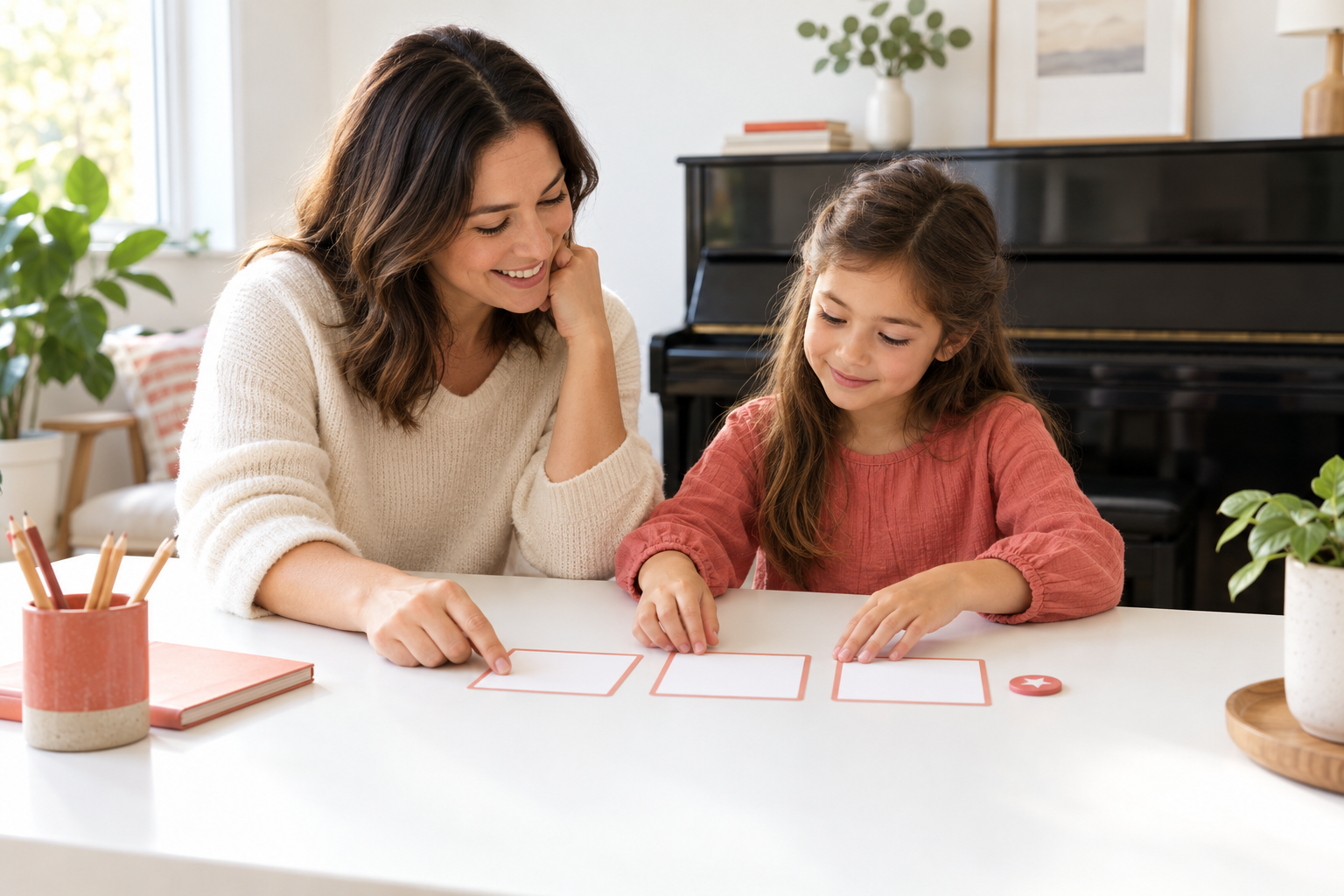
What does it mean for a child to learn a piano song?
Parents often ask about one finish line, but beginner learning usually has at least three:
- Find it. The child can locate the starting place, recognize the main pattern, and play a small section with the assigned notes or fingers.
- Connect it. The child can join short sections, keep a reasonably steady pulse, and recover without returning to the beginning after every slip.
- Share it. The child can play the song from an agreed starting point with enough comfort to listen to the sound, show a teacher, or perform it for someone.
A child may reach the first stage quickly and spend much longer on the second. That is normal when a piece adds reading, rhythm, two-hand coordination, or a new movement. Avoid calling the early version “not learned” simply because it is not ready for a recital.
How long should a beginner piano song take?
For a new beginner, think in focused practice visits rather than a promised number of days. A very short song using familiar notes and one hand may come together over several visits. A song that adds both hands, position changes, new rhythms, or a longer form may need several weeks. The teacher should choose a piece whose challenge matches the child’s current skills.
| What the song asks | A useful first goal | Evidence of progress |
|---|---|---|
| Familiar notes and rhythm | Play one short phrase at a comfortable pace | Less searching between notes |
| One new rhythm or movement | Isolate the new part before reconnecting it | The child can explain or demonstrate the new job |
| Both hands with simple roles | Join the first shared beat, then add the next event | Fewer stops at the same hand change |
| A longer song | Learn beginning, middle, and ending as separate sections | The child can start from more than one place |
This is why comparing two children by the number of songs they finish is misleading. One child may be reviewing short familiar patterns while another is learning a first left-hand part. The title count is different, but both children may be making useful progress.
Daily practice length matters less than whether the session has a clear job. The iPianoLab guide to how long children should practice piano gives a flexible teacher-first starting point.
What makes a piano song take longer to learn?
The song contains several new skills at once
A child may know the notes but still be learning the rhythm, fingering, hand position, dynamics, or pedal. When several of those are new, the song is not one task. Ask the teacher which layer should come first.
The child always starts from the beginning
Repeatedly playing the opening can make it strong while the middle stays unfamiliar. Choose a small middle starting point and practice arriving there directly. The guide to starting a piano song after a mistake explains how to build a beginning, middle, and ending map.
The child is using a different fingering each time
A changing finger plan changes the distance and movement into the next note. Follow the teacher’s marked fingering when one is provided. If it feels uncomfortable, ask before inventing a replacement that may create a new problem later in the phrase.
The tempo is faster than the child can plan
Fast attempts can hide where learning actually breaks down. Use a pace that leaves time to see the next note and prepare the movement. Speed is a later result, not proof that the song is ready.
Practice repeats the whole song instead of the problem
Playing a page five times gives the difficult measure only five attempts. Practicing that one measure for a few calm repetitions gives the child a clearer experiment. Reconnect it to the phrase afterward so the repair belongs in the music.
A three-stage map for learning one beginner piano song
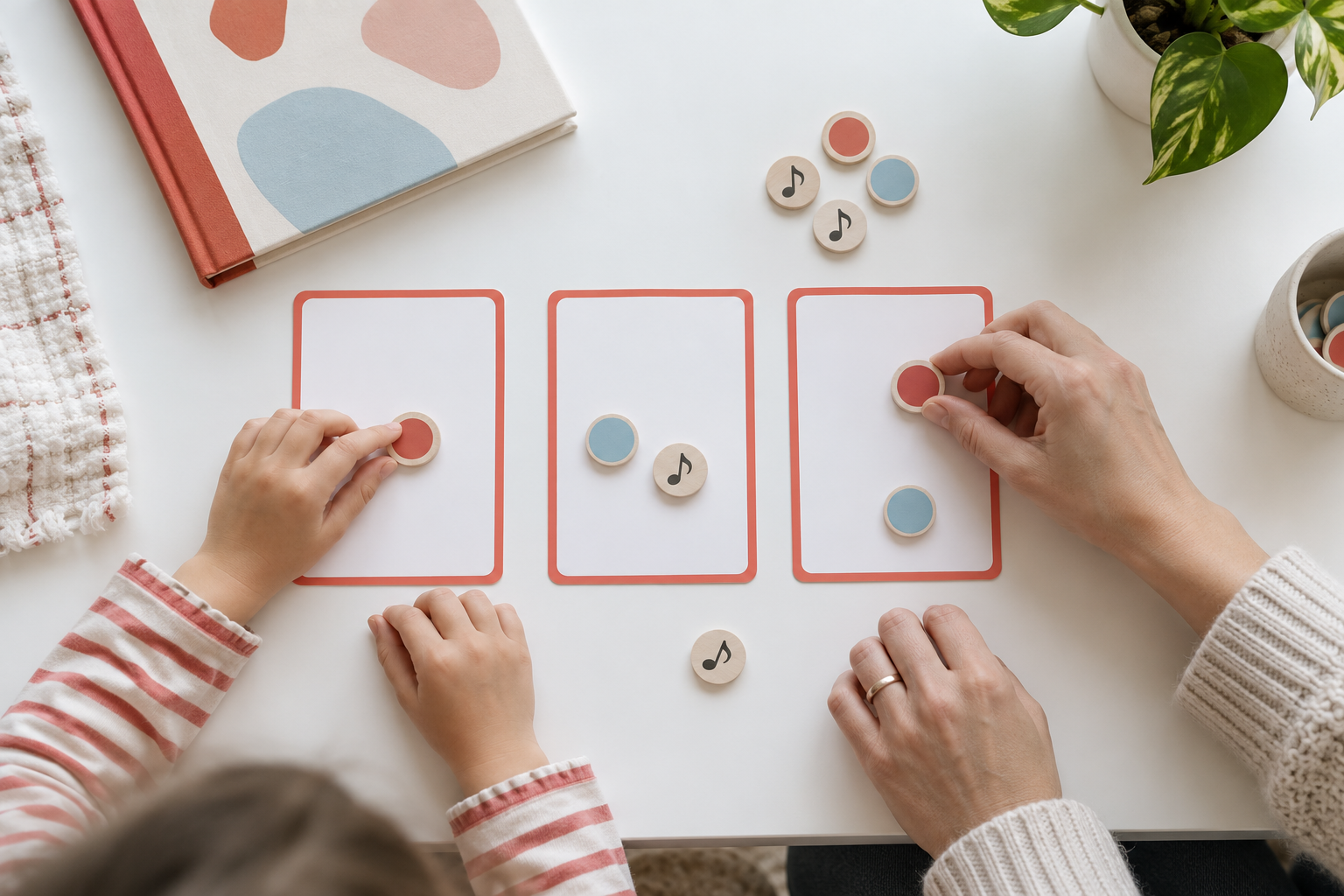
Stage 1: Choose the smallest useful section
Ask the child or teacher to identify one phrase, measure, hand change, or rhythm. Begin close to the difficulty instead of replaying everything before it. A useful section is small enough that the child knows what to notice.
Stage 2: Make one thing clearer
Decide whether the goal is notes, rhythm, fingering, movement, or sound. Work on only that job for a few attempts. If the child keeps playing a wrong note, use the point, place, play routine for wrong piano notes rather than correcting the whole line at once.
Stage 3: Reconnect and finish musically
Add one small step before and after the repaired spot. Then finish with a familiar phrase or song. The child should leave practice knowing what improved, not feeling that every unfinished detail is a failure.
Faber Piano Adventures’ parent guidance also emphasizes that practice length and structure grow with the student rather than following one fixed requirement for every child. See the Faber Piano Adventures parent FAQ for its teacher- and assignment-led context.
How can parents tell whether a song is a good fit?
A well-matched song does not need to feel easy on the first day. It should, however, contain an understandable next step. Look for these signs over several practices:
- The child can identify the starting place without a long search.
- At least one short section becomes steadier or easier.
- The same correction works more often instead of creating a new problem.
- The child can describe what they are practicing in simple language.
- The teacher can name the main skill the song is developing.
- Practice can end before tension, pain, or a prolonged argument takes over.
A song may be temporarily too large if the child cannot find a workable section, every measure adds a different unfamiliar skill, both hands remain confusing even in a tiny group, or practice repeatedly ends in distress. That does not mean the child lacks ability. It means the current version or assignment may need to be simplified.
If both hands are the main obstacle, use the separate guide to helping a child play piano with both hands.
When should parents ask the piano teacher to change the plan?
Ask for a clearer or smaller assignment when the same place has not changed after several attentive practices, the child does not understand what the song is teaching, the marked fingering feels uncomfortable, or the music causes repeated tension or pain. Bring one specific observation:
“The first phrase is comfortable, but both hands stop at the same change in the middle. What is the smallest version we should practice this week?”
That gives the teacher useful evidence. They can shorten the section, simplify one hand, change the tempo, clarify a rhythm, choose a different fingering, or select a better-matched song. Parents do not need to design a new curriculum between lessons.
If your family is choosing a beginner program, look for a path that connects enjoyable songs with keyboard geography, rhythm, counting, note reading, and coordination in manageable steps. Explore iPianoLab online learning, or choose an iPianoLab program for your child.
Frequently asked questions
Can a child learn a piano song in one lesson?
A child may learn a very short pattern or recognizable part in one lesson. That does not mean every note, rhythm, movement, and performance detail is finished. The teacher may intentionally introduce one stage and leave the next stage for home practice.
Is it normal for one beginner song to take several weeks?
Yes, when the song adds a meaningful new skill or is learned in manageable sections. Ask what is improving each week. If nothing is becoming clearer, the teacher should adjust the assignment rather than simply extending the deadline.
How many songs should a beginner learn each month?
There is no useful universal number. Song length, difficulty, lesson goals, and the child’s experience all change the count. A balanced plan may include a new teaching piece, an easy review piece, and something the child plays for enjoyment.
Should a child master one song before starting another?
Not always. Teachers often use different songs for different skills and keep an easier piece active while a harder one develops. Ask which song is for learning, which is for review, and which is ready to share.
Does memorizing a song mean it is learned?
Memorization is one useful skill, but it does not automatically show steady rhythm, flexible starting points, reading, or comfortable movement. A child can know the sound and still need help with another layer.
What if my child can play the song at home but not in the lesson?
A new room, instrument, audience, or starting request can make retrieval harder. Practice beginning from two or three places and occasionally play for one supportive listener. Tell the teacher what the child can do at home so the lesson can test the right next step.
When is a beginner piano song finished?
Use the teacher’s goal. A song may be finished when it has taught its main skill, even if it is not a polished performance piece. Other songs may stay in review because the child enjoys them or is preparing to share them.