How to Support Your Child’s Piano Progress (Even if You Don’t Know a Single Note)
![[HERO] How to Support Your Child’s Piano Progress (Even if You Don’t Know a Single Note)](https://ipianolab.s3.us-west-2.amazonaws.com/blog/posts/24/assets/marblism/cdn.marblism.com/NprzegF7XdC.webp)
Does the following scene sound familiar? Your child sits down at the keyboard, opens their book, and starts playing. You stand there, nodding along, trying to look supportive while secretly thinking, “Is that supposed to sound like ‘Baby Shark’ or a blender full of marbles?”
If you don’t know the difference between a G-clef and a meat cleaver, don’t panic. You are not alone. In fact, many of our most successful students at iPianoLab come from homes where the parents couldn't play a single note if their lives depended on it.
The "I'm not musical" fear is one of the biggest hurdles parents face. You might worry that you can’t help them practice, or that you won’t notice if they’re making mistakes. The good news is: You don’t need to be Mozart to help your child master the keys. In many ways, being a "non-musical" parent is actually an advantage. You get to be the ultimate cheerleader, the curious audience, and the supportive coach without the temptation to over-correct every finger slip.
At iPianoLab, which is officially transitioning to our exciting new brand, PianoFlight, this summer, we’ve designed our method to be parent-friendly. We handle the heavy lifting of the theory and technique, so you can focus on the motivation.
Here are five simple, low-stress ways you can support your child’s piano journey, even if you’ve never touched a piano in your life.
Tip 1: Be the “Active Listener” (And Let Them Be the Teacher)
One of the most powerful ways to help a child learn is to let them explain what they’re doing. This is often called the “Protégé Effect.” When you teach someone else, your brain organizes information more clearly.
You don’t need to know if they hit a B-flat instead of a B-natural. Instead, ask questions like:
- "Hey, that sounded cool! What's the name of that song?"
- "Which hand is doing the most work in this part?"
- "Can you show me where ‘Middle C’ is? I always forget."
By playing the role of the curious student, you take the pressure off. You aren't "judging" their practice; you’re participating in it. If they can explain a concept to you, like what a "quarter note" is, they’ve officially mastered it. Plus, it makes them feel like the expert in the room, which is a massive confidence booster.
A young student proudly showing their parent how to find notes on a piano keyboard, fostering a sense of accomplishment.
Tip 2: Schedule “Showcase” Moments
Traditional recitals can be terrifying. Getting dressed up in itchy clothes to play in a quiet room full of strangers? That’s a lot of pressure for a seven-year-old. While those have their place, the real magic happens in your living room.
Create "Mini-Concerts" or "Showcase Moments." This doesn't have to be a formal event. It can be as simple as saying, "Hey, before we have dessert, do you want to play that new 8-bar loop you learned today?"
The Goal: Make performing a normal, low-stakes part of life.
The Reward: Use a simple reward system to celebrate these mini-performances. Maybe they get to pick the movie on Friday night or earn a "music star" on a chart.
If you ever feel like your child needs a more "professional" setting to feel like a real rockstar, or if you just need a quiet space with a high-end instrument for them to practice on, check out Lenox Hill Music Studios. It’s a great way to show them that music is a "real world" skill beyond the living room.
Tip 3: Create a Consistent Routine (Not a Chore)
Consistency is the "secret sauce" of music education. But let’s be real: "Go practice your piano!" is often the start of a domestic Cold War.
Instead of focusing on how long they practice, focus on when they practice. Research shows that 10 minutes a day, five days a week, is infinitely better than one hour-long marathon on Sunday night.
Try to anchor piano time to something that already happens.
- "The Pre-Snack Strum": They play two songs, then they get their after-school snack.
- "The Commercial Break Jam": If they’re watching a show, they hit the keys for five minutes during the break.
Make the piano accessible. If the keyboard is tucked away in a dusty corner or kept inside a case, they won’t play it. Keep it in a high-traffic area where they can just sit down and plink for a minute or two as they walk by. If you’re still looking for the right setup, our Keyboard Buyer’s Guide can help you find something that fits your space and budget.
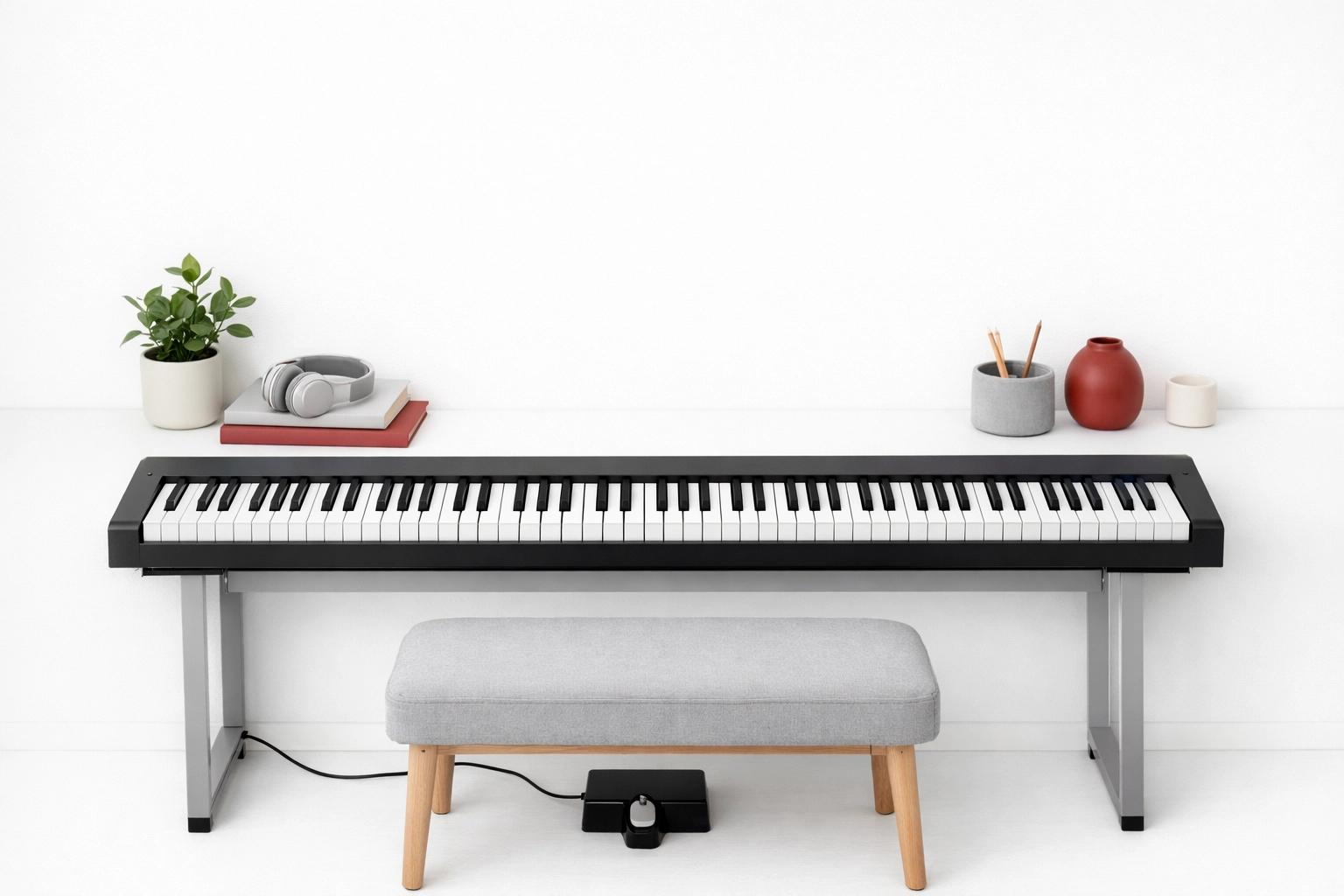
A cozy home music corner with a digital piano showing the correct alternating 2-and-3 black key pattern, set up and ready to play.
Tip 4: Celebrate the “Small Wins”
As a non-musical parent, you might not know when they’ve mastered a complex rhythm, but you can tell when they’ve been working hard on something.
In piano, progress isn't always a straight line. Sometimes a student will spend three days struggling with just four measures of music. When they finally get through those four measures without stopping: that is a huge win.
Celebrate the "Messy Middle."
- "I noticed you kept trying that one part even when it was tricky. Great job staying with it!"
- "That sounded much smoother than yesterday!"
At iPianoLab and our upcoming PianoFlight platform, we focus on "Song-First" learning. This means kids are playing recognizable tunes almost immediately. This makes it much easier for you to recognize those wins! You’ll hear the melody take shape, and that’s your cue to give a literal (or figurative) high-five.
Tip 5: Trust the Tech (The iPianoLab & PianoFlight Approach)
You don't have to be the teacher because we’ve spent years perfecting a system that does the teaching for you. Whether your child is in one of our after-school programs or taking online lessons, we use a proprietary "Visual-First" method.
We are moving toward the future of music education with PianoFlight. This transition isn't just a name change; it's a commitment to making piano lessons the most engaging part of a kid's week. We combine real, live teachers with interactive video tutorials and games.
Here’s how you "Trust the Tech":
- Use the Portal: Let your child show you the free stuff or the lesson videos. Even if you don't understand the music theory, you can see if they are following along with the video.
- Let the games do the work: If they are playing one of our rhythm games, they are learning. It might look like "screen time," but it’s actually building the neural pathways for timing and coordination.
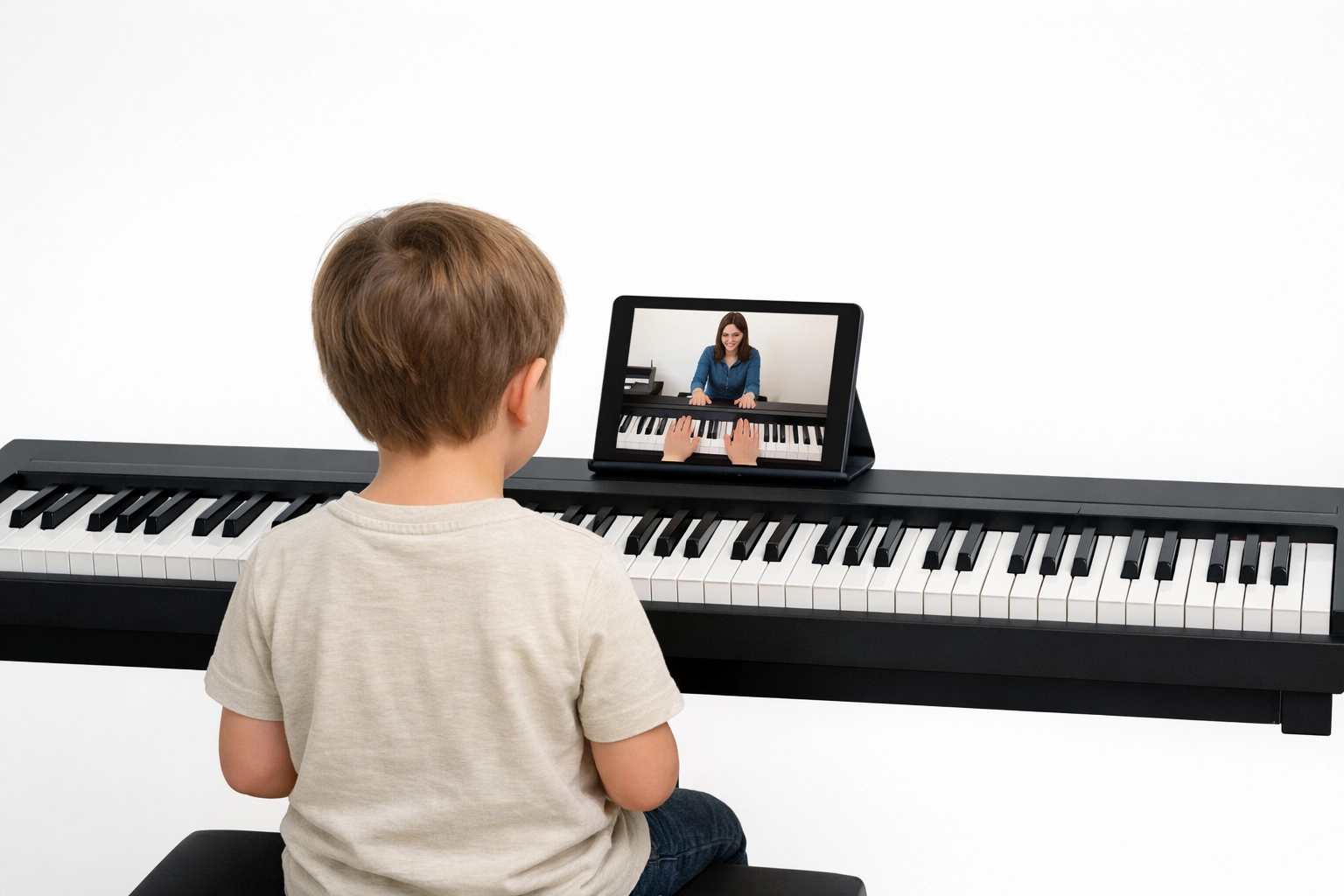
A child using a tablet alongside their piano, showing a piano lesson video while they face the keys.
Conclusion: We’re In This Together
Supporting your child’s musical journey doesn't require a degree from Juilliard. It requires patience, a bit of curiosity, and a willingness to be their biggest fan. By creating a routine, celebrating the struggle, and using the tools provided by iPianoLab, you’re giving your child a gift that lasts a lifetime.
Remember, this summer we are officially taking off as PianoFlight! It’s the same incredible teachers and "Song-First" method you love, but with a fresh look and even more tools to make learning fly.
If you want to give your child an extra boost or looking for a professional environment to supplement their learning, don't forget to visit Lenox Hill Music Studios. And if you're ready to get started with us, you can sign up here to join the family.
You’ve got this. Now, go ask your kid to teach you where "Middle C" is. They’ll love showing off!
A parent and child laughing together at a single digital piano with the correct 2-and-3 black key grouping, showing that music is about connection, not perfection.