Should Kids Look at Their Hands While Playing Piano?
Yes. It is normal for beginner pianists to look at their hands and the keys. A quick glance can help a child find a starting note, check a new hand position, or prepare for a jump. The goal is not to make a child play with their eyes closed. The goal is to help them look with a purpose, then return their attention to the music or lesson cue without losing their place.
Looking becomes a problem only when a child must watch every finger for every note, stops each time their eyes move, or memorizes a song mainly to avoid reading. Parents can help by using a simple pattern: read first, glance when needed, then return.
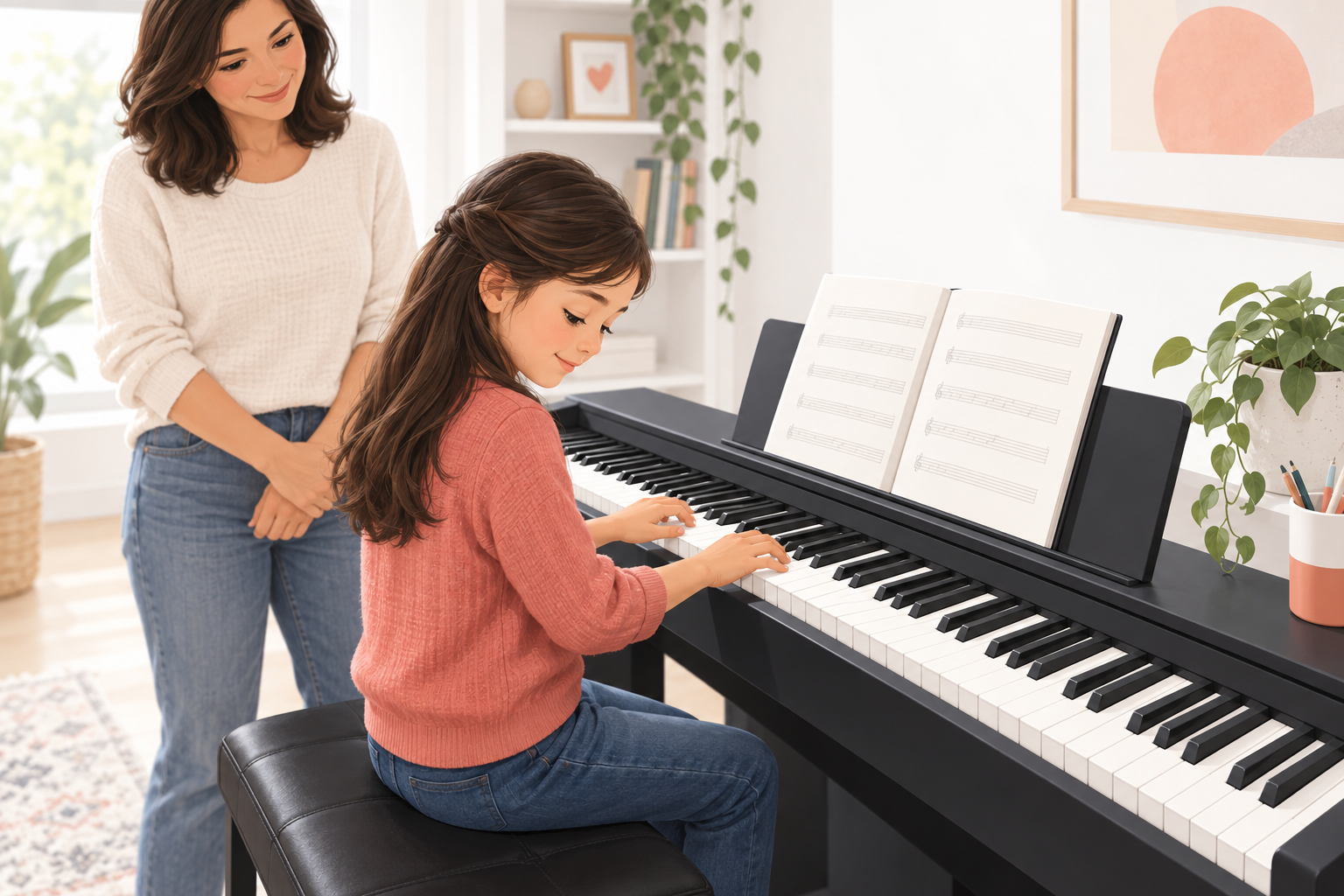
Is it bad to look at your hands while playing piano?
No. Pianists use their eyes for several jobs: reading music, following a lesson on a screen, checking hand position, and seeing where the hands need to move. A beginner may need more visual checks because keyboard geography and movement patterns are still new.
A helpful glance answers a specific question: “Where does my hand land?” or “Am I starting in the right group of keys?” An unhelpful habit makes the child dependent on watching every motion. The difference is not whether the child looks down. It is whether the glance supports steady playing or interrupts it.
When should a child look at the piano keys?
Looking at the keyboard can be useful when a child is:
- finding the starting note or hand position;
- moving to a new area of the keyboard;
- checking the repeating groups of two and three black keys;
- learning a new fingering or chord shape;
- playing a larger jump; or
- checking whether relaxed hands are in the intended place.
These glances are part of learning the keyboard. Over time, the child should need fewer checks for familiar notes and patterns. That change usually comes from repetition and a clearer mental map, not from being told to stop looking immediately.
When should a child look back at the music?
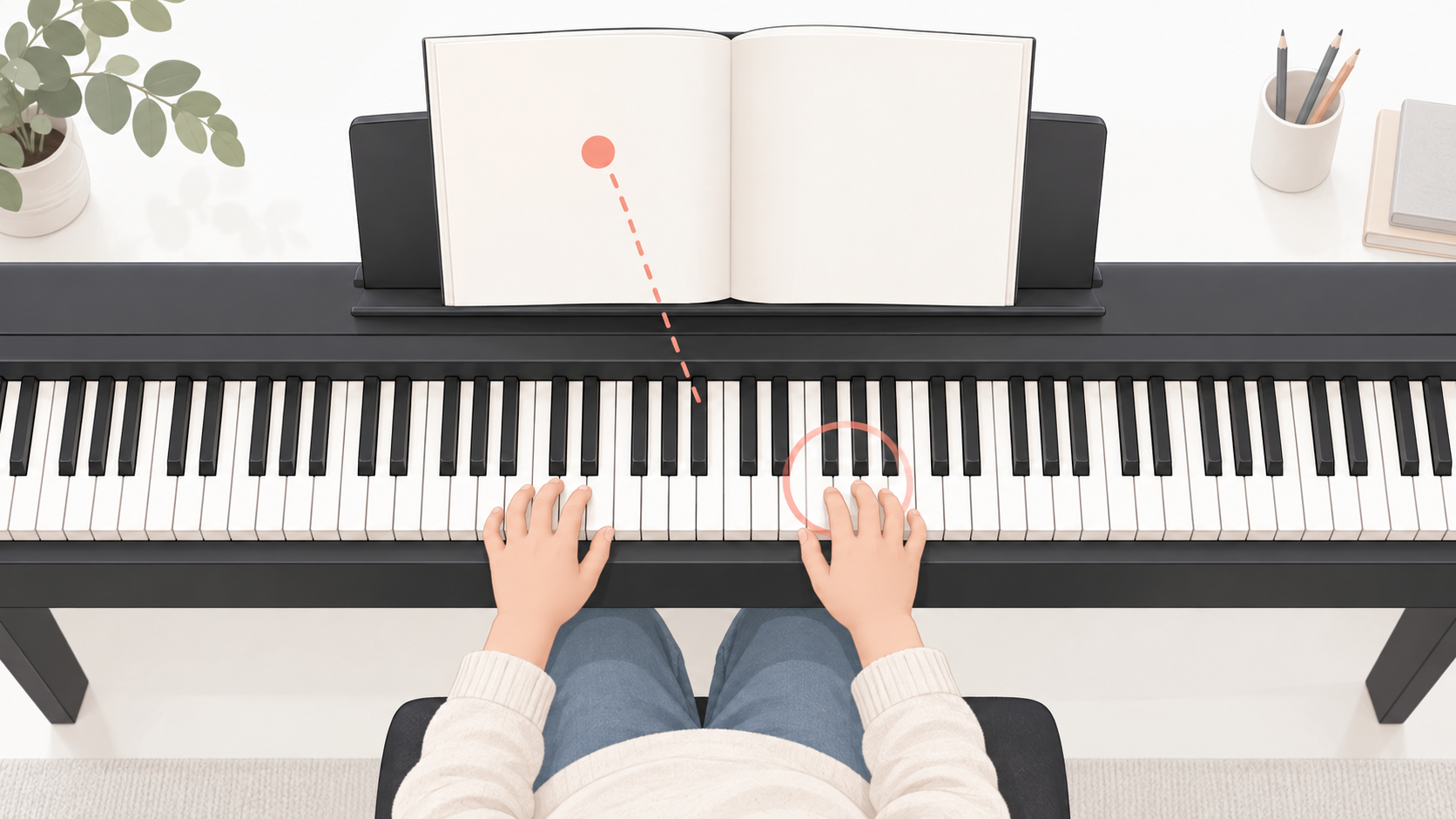
If a child is reading from a page or screen, their eyes need to return before they lose the next beat or forget the next instruction. Try this order:
- Read the next small musical idea. That might be one measure, one pattern, or one chord change.
- Prepare the movement. Say the starting note, find a group of black keys, or identify where the hand needs to move.
- Glance at the destination. Look down briefly if the hand needs visual help.
- Return to the music. Bring the eyes back before playing the next idea.
The section must be small enough for the child to hold in mind. A brand-new beginner may work with two or three notes. An older or more experienced student may prepare a full measure or phrase.
How can you tell if a child looks at their hands too much?
One glance is not the issue. Watch for a repeated pattern that makes playing harder:
- The child stops each time they look from the page to the keys.
- They lose their place in the music after every glance.
- Their head moves up and down for nearly every note.
- They can play only after memorizing the piece.
- They know note names on the page but still search for every key.
- They stare at one hand and stop listening to the other hand.
These signs do not mean the child is lazy or learning incorrectly. They show which link needs practice: reading ahead, finding keyboard landmarks, keeping a steady pulse, or returning to the same place on the page.
If memory is doing all the work, use this related guide on balancing memorization with reading and listening.
A five-minute read-glance-return routine for kids
Use an easy section your child can already play slowly. This is an eye-and-attention exercise, not a test of a difficult song.
- Find two keyboard landmarks. Ask your child to notice one group of two black keys and one group of three. Use those landmarks to find the starting area.
- Read before touching the keys. Look at the first two to four notes, a short pattern, or one chord change.
- Place the hands. Make one quick glance to confirm the starting position.
- Play the small idea. Keep the eyes on the music if possible. If another glance is needed, make it brief and purposeful.
- Freeze at the end. Check whether the eyes returned to the page and whether the beat stayed steady.
- Repeat once. Try the same idea again with one fewer glance, not with more speed.
Stop after a few successful repetitions. A short, clear practice loop is more useful than turning eye position into a long correction session. If combining both hands is the harder problem, use iPianoLab’s guide to helping a child play piano with both hands.
Three ways to build keyboard geography without pressure
1. Find groups, not isolated keys
The piano keyboard repeats. Help your child notice groups of two black keys and groups of three, then use them to find nearby white keys. This gives the child a dependable map instead of asking them to memorize a long row.
2. Keep one hand in a familiar area
Before adding jumps, let the child practice a short pattern in one comfortable position. Familiar movement makes it easier to look back at the music and listen to the result.
3. Separate the eye task from the song task
Practice looking up and down with an easy pattern before trying it in the difficult measure. When the notes are simple, the child can pay attention to the glance itself.
What should parents say during practice?
Use a neutral question instead of a command such as “Stop looking at your hands.” Try:
- “What do you need to see before you play?”
- “Can you read the next small part first?”
- “Where will your hand land?”
- “Did that glance help you keep going?”
- “Can you try it once with one fewer look?”
The parent does not need to judge every note. You can help the child make the task smaller, protect a calm practice window, and notice a specific improvement such as returning to the page without stopping.
When should you ask the piano teacher for help?
Ask the teacher to demonstrate the intended eye pattern when your child repeatedly loses their place, cannot find the starting position, or is unsure whether the music should be read or memorized. A useful question is: “What should my child look at during this exact section?”
The answer may change from one piece to another. A teacher may want the child to read closely, memorize one movement, watch a hand jump, or listen without focusing on the page. Clear instructions are more useful than a universal rule.
How iPianoLab helps beginners connect eyes, ears, and hands
iPianoLab helps children make music early while building keyboard geography, rhythm, counting, note reading, two-hand coordination, melody, chords, and music literacy. Those skills work together: children read a cue, find it on the keyboard, hear the result, and learn what to do next.
Families can explore iPianoLab online learning or choose a beginner-friendly starting path.
Frequently asked questions
Should beginner pianists look at the keys?
Yes. Beginners often need to look at the keys to find starting notes, understand keyboard geography, and prepare hand movements. The goal is to make those glances brief and purposeful as familiarity grows.
Should a child play piano without looking at their hands?
Not all the time. Playing an easy pattern without looking can build keyboard awareness, but forcing a child never to look may add mistakes and tension. Practice short, familiar sections and keep the teacher’s purpose clear.
Why does my child lose their place when looking down?
The child may be reading too large a section, moving their head for every note, or not marking where the eyes should return. Work with two to four notes at a time and ask the teacher to show the return point on the page.
Is memorizing music the same as learning not to look at the keys?
No. Memorizing removes the need to look at the page, but the child may still watch the hands. Reading, memory, listening, and keyboard awareness are separate skills that should support one another.
How long does it take to stop watching every finger?
There is no single timeline. It depends on the child, the music, the size of the movements, and how often the same patterns return. Look for gradual change: fewer glances in familiar sections and less interruption when a glance is needed.