Is This Piano Song Too Hard for My Child? A Parent Guide
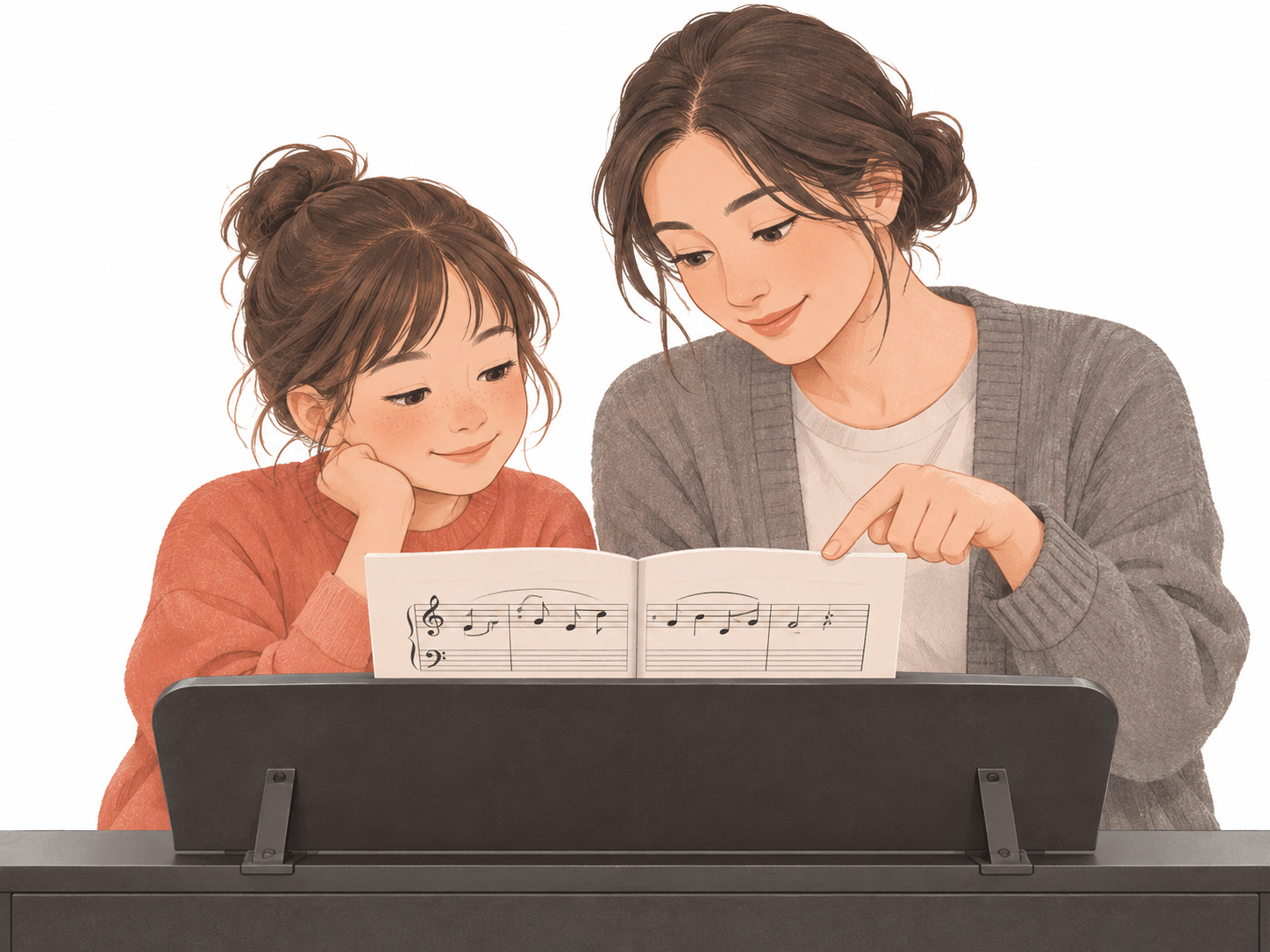
A piano song can feel hard for several different reasons. It may be new, one measure may need a smaller practice step, or the piece may ask for more skills than your child can use comfortably right now.
The quickest test is not whether your child makes mistakes. Beginners are supposed to make mistakes while learning. Ask instead: can your child understand the next step, make a small improvement during a short practice session, and play without pain or growing tension?
If the answer is yes, the song may be a healthy challenge. If the answer is repeatedly no, the teacher may need to simplify the assignment, choose a shorter section, or change the music.
The short answer
A beginner song is probably challenging in a useful way when your child can:
- identify one small part to practice;
- make the rhythm or notes a little clearer after a few careful tries;
- recover after a mistake;
- explain what the teacher asked them to do; and
- finish a short session feeling capable enough to return.
The song may be too hard right now when the child cannot begin without the whole lesson being retaught, every attempt falls apart at the same basic step, the hands or body become increasingly tense, or several short sessions produce no clearer understanding of what to do next.
One difficult spot does not automatically make the whole song too hard. Often the best response is to isolate that spot and shrink the task.
Five signs the song may be too hard right now
1. Your child cannot explain the first step
Ask, “What are you trying to do in this part?” A useful answer can be simple: find the starting notes, clap the rhythm, play one hand, or repeat two measures slowly.
If your child cannot name or demonstrate any next step, the problem may be assignment clarity rather than effort. Check the written assignment, lesson resource, or teacher message before adding more practice time.
2. Notes and rhythm fall apart even when separated
A child may need to work on notes and rhythm separately before combining them. Try clapping the rhythm away from the keyboard, then finding only the starting notes.
If both tasks remain confusing after a clear demonstration, the music may depend on skills that have not been introduced securely enough yet. That is useful information for the teacher.
3. The same short section creates growing tension
Watch the whole child, not only the wrong notes. Raised shoulders, a rigid wrist, breath-holding, repeated force, or visible panic can mean the task has become too large.
Stop if your child reports pain, tingling, or unusual discomfort. More repetitions are not the right response to pain. Tell the teacher exactly where and when it appears.
4. Several short sessions produce no usable improvement
A new song does not need to sound polished quickly. Look for a smaller sign of learning: a steadier beat, a correct starting place, fewer pauses, one hand that feels more secure, or a child who can describe the difficult spot.
If three short, focused sessions produce no clearer understanding or control, do not keep extending the session. Ask the teacher whether to reduce the section, change the approach, or choose different music.
5. Your child needs an adult to supply every note and finger
Some parent support is normal, especially for young beginners. The adult can start the routine, read the assignment, and help protect a short practice window.
But if the child can move only when an adult names every note, finger, and correction, the assignment may be asking for too much independent decoding. The teacher may need to demonstrate a smaller target or provide a more usable practice cue.
A five-minute piano-song difficulty check
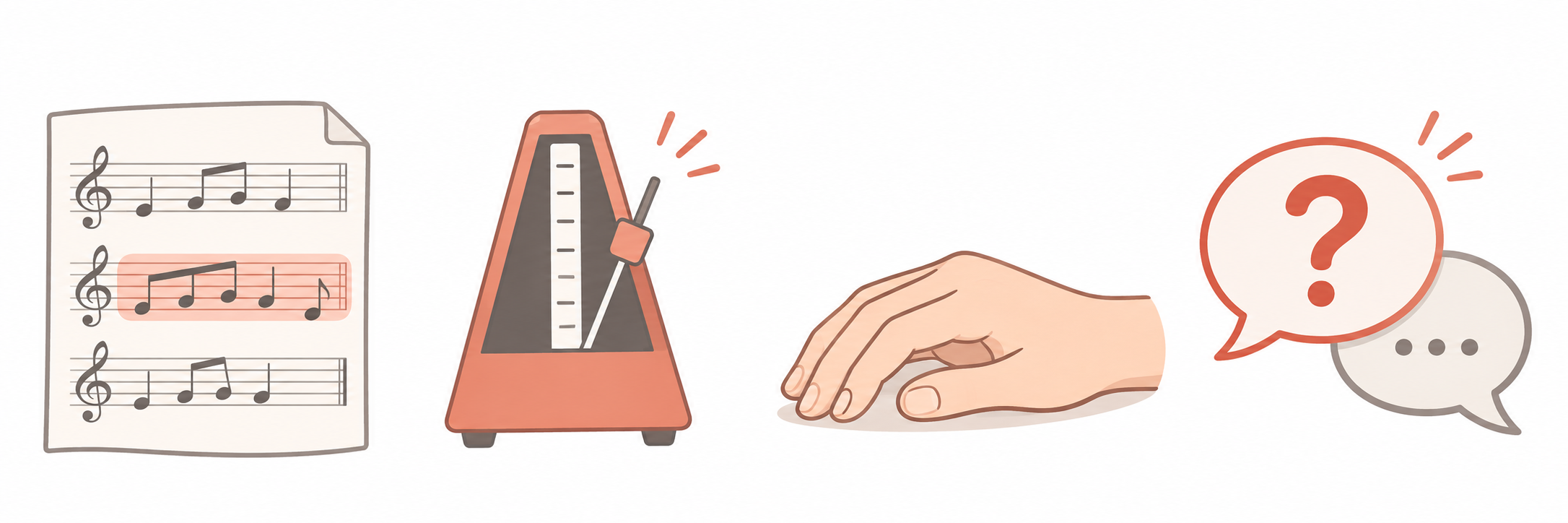
Use this check once, not as a new daily test.
- Listen to one complete attempt. Do not interrupt every mistake. Notice where the music first loses its shape.
- Choose the smallest difficult section. Use one phrase, one measure, or even two nearby notes.
- Remove one layer. Clap the rhythm, play one hand, or find only the starting position if that matches the teacher’s method.
- Try the small section twice. Listen for one specific improvement rather than a perfect performance.
- Name the next step. Ask your child what they would repeat tomorrow or what they need to ask the teacher.
If the smaller version becomes clearer, the song may not be too hard; the original practice target was simply too large. If the child still cannot understand the task, record the exact spot and ask the teacher for the next smaller step.
Is the song too hard, or just new?
| What you notice | Often a normal new-song challenge | Worth asking the teacher |
|---|---|---|
| Mistakes | Errors change as the child learns | The same basic breakdown continues with no clearer plan |
| Rhythm | A short phrase becomes steadier after clapping | The child cannot identify or copy the beat |
| Notes | Starting notes become easier to find | Every note requires adult prompting |
| Coordination | One hand works before both hands are combined | Neither hand can complete the small pattern comfortably |
| Confidence | Frustration settles after the task is reduced | Distress grows even when the task is made smaller |
| Body | The child can reset and play comfortably | Pain, tingling, rigid posture, or repeated breath-holding appears |
What parents should do instead of saying “Try harder”
Use a sentence that points to a concrete next action:
- “Show me the smallest part that feels confusing.”
- “Can we clap the rhythm before playing it?”
- “Which hand should we try first?”
- “What did your teacher ask you to listen for?”
- “Let’s write down one question for the next lesson.”
Avoid increasing the practice time just because the song is difficult. A longer session can repeat confusion without building the missing skill.
Parents do not need to decide alone whether the piece should be replaced. Their most useful job is to observe the pattern and describe it clearly.
What should you ask the piano teacher?
Bring a specific observation instead of saying only, “This song is too hard.”
Try:
- “My child can clap the rhythm but cannot find the starting position.”
- “The right hand works alone, but both hands create tension.”
- “We reduced the task to two measures, and the same transition is still unclear.”
- “My child needs us to name every note. What should they be able to do independently?”
- “Should we keep this song, simplify it, or use another piece to build the missing skill?”
The teacher can then check whether the issue is rhythm, note reading, fingering, coordination, practice instructions, or the musical level itself.
How iPianoLab approaches beginner progress
iPianoLab helps children play songs they enjoy while building keyboard geography, rhythm, counting, note reading, melody, chords, two-hand coordination, and music literacy over time.
After-school classes commonly meet once weekly for one hour, and each level includes six lessons. That structure gives families a natural checkpoint for asking what the child can do now, which skill comes next, and whether the current music is a useful match. The iPianoLab FAQ also explains the class equipment, home-keyboard guidance, materials, and online resources included for enrolled students.
Frequently asked questions
Should I let my child skip a piano song that feels too hard?
Do not decide from one difficult practice session. Reduce the task, try one short check, and ask the teacher what the song is meant to teach. A different song may be appropriate, but the decision should preserve the intended skill rather than simply removing every challenge.
How many times should a child repeat a difficult section?
Use a small number of careful attempts and listen for understanding. Repeating a confusing section many times can make the frustration more familiar without making the music clearer. Stop when the child no longer knows what to change.
Is frustration normal in piano practice?
Brief frustration can be part of learning. It becomes a stronger warning when it grows across several short sessions, prevents the child from trying a smaller step, or appears with pain, panic, or repeated physical tension.
Does playing slowly mean the song is too hard?
No. Slow practice is often how a child gives the brain and hands time to coordinate. The useful question is whether the child can keep a small section controlled and increasingly clear at that slower pace.
What if only one measure is difficult?
Treat that measure as its own small assignment. Work on the rhythm, starting position, or one hand only if the teacher has introduced that approach. One difficult measure rarely means the entire song must be abandoned.