Can AI Really Help Your Child Learn Piano? The Truth About Digital Music Coaches vs. Certified Teachers
![[HERO] Can AI Really Help Your Child Learn Piano? The Truth About Digital Music Coaches vs. Certified Teachers](https://ipianolab.s3.us-west-2.amazonaws.com/blog/posts/21/assets/marblism/cdn.marblism.com/HjuNVsk1BXj.webp)
It’s March 2026, and let’s face it, AI is doing just about everything. From writing emails to driving cars, artificial intelligence has woven itself into the fabric of our daily lives. So, it’s no surprise that the world of piano lessons for kids has been completely transformed.
If you’ve browsed the app store lately, you’ve probably seen dozens of "AI Music Coaches" promising to turn your child into the next Mozart in six weeks for the price of a latte. It sounds incredible, right? No more driving to lessons, no more scheduling conflicts, and a teacher that lives in your iPad.
But as we settle into this new era of music education 2026, parents are asking the big question: Can a computer really replace a human teacher?
The short answer? It’s complicated. The long answer is much more exciting. At iPianoLab, which will officially become PianoFlight this summer, we’ve spent years perfecting the balance between high-tech tools and the essential human touch.
Let’s dive into the truth about digital music coaches versus certified teachers, and how you can find the perfect path for your child.
The Rise of the AI Music Coach: What’s the Big Deal?
There’s no question about it: AI in music education is having a massive moment. By 2025, studies were already showing that students using AI-based feedback improved their technical scores significantly compared to those practicing in a vacuum.
The appeal is obvious. An AI coach is always there. Whether your child wants to practice at 7:00 AM on a Saturday or 8:00 PM on a Tuesday, the "teacher" is ready.
The Pros: Why Digital Coaches Are Actually Pretty Cool
The good news is that technology has solved some of the biggest hurdles for beginner piano lessons. Here is what AI does exceptionally well:
- Instant Feedback: Back in the day, a student might practice a song with the wrong notes all week long, only to have the teacher correct them at the next lesson. AI catches that mistake instantly. Research shows that just 10 minutes of AI-corrected practice can be more effective than an hour of unguided practice.
- Gamification: Let’s be real, traditional scales can be boring for a seven-year-old. AI apps turn practice into a game with points, levels, and badges. If it feels like Minecraft, they’re going to keep playing.
- Adaptive Difficulty: Modern AI systems are smart enough to realize when a child is struggling. If a section is too hard, the software automatically slows down or simplifies the arrangement so the child doesn't get frustrated and quit.
- No "Nagging" Required: When the app is giving the feedback, you don't have to be the "bad guy." We actually wrote a whole guide on how to get your kids to practice piano without the nagging because we know how tough that battle can be!
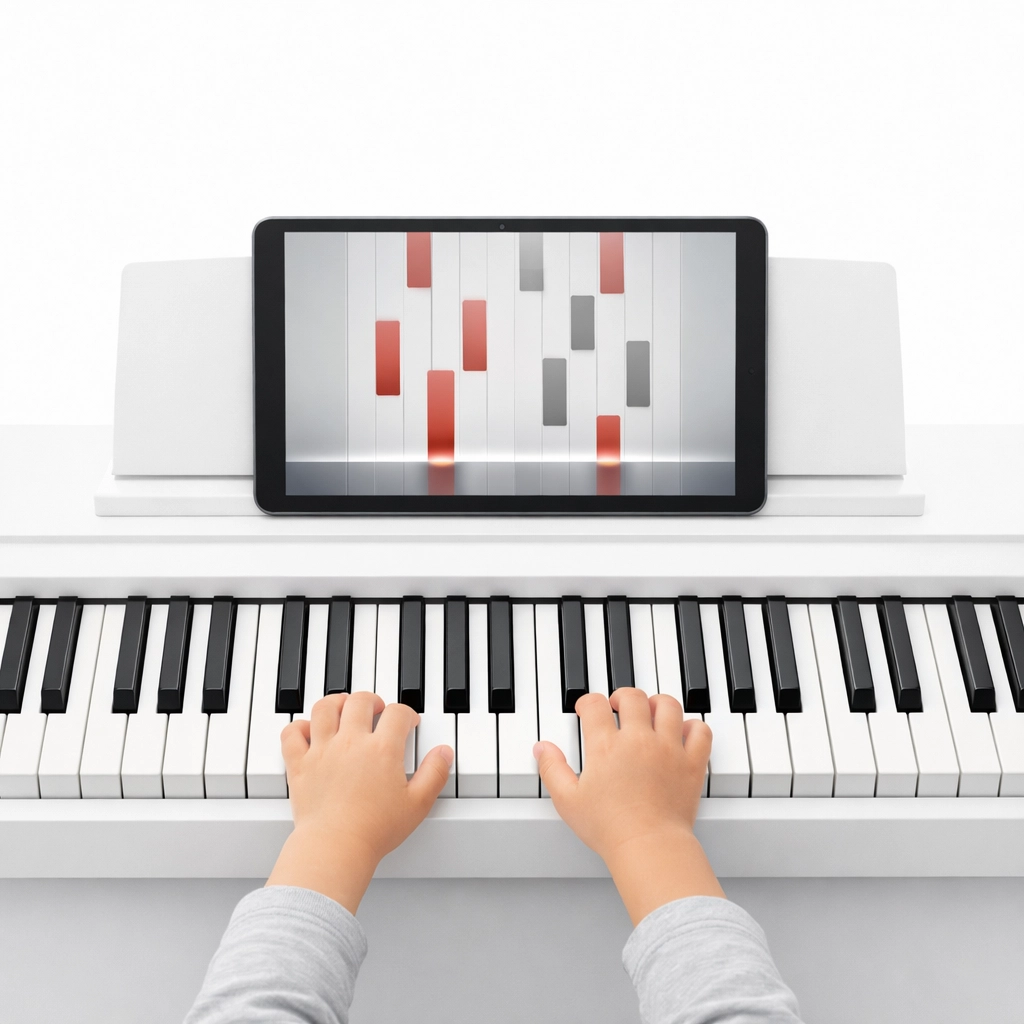
The "Robot" Problem: Where AI Hits a Wall
While a digital coach is great for knowing which note was played, it’s remarkably bad at knowing how it was played. This is where the limitations of 2026 technology become clear.
The Cons: What’s Missing?
- The "Robot" Hand: AI can tell if you hit a Middle C. It can't easily see if your child’s wrist is locked, their shoulders are hunched, or if they are developing a "claw" grip that will cause pain later.
- Musicality and Soul: Piano isn't just about hitting buttons in the right order. It’s about phrasing, emotion, and "storytelling" through sound. An AI doesn't feel the "sadness" of a minor chord or the "triumph" of a crescendo. It just sees data.
- The Human Connection: For many kids, the reason they stick with piano is because they love their teacher. A certified teacher offers encouragement, laughs at their jokes, and knows exactly when to push and when to offer a high-five. A screen just can't do that.
The Future is Hybrid: The PianoFlight Vision
At iPianoLab, we’ve seen both sides of the coin. We know that kids love tech, but they need mentors. That’s why our approach, and the core of our new PianoFlight brand, is built on a Hybrid Solution.
We believe that technology should supplement, not replace, the human element. We aren't just an app. We are a team of certified, world-class instructors who use proprietary technology to make the journey faster and more fun.
We use online lesson videos, interactive tutorials, and games to keep kids engaged between lessons, but a real human teacher is always at the heart of the journey. Whether your child is in one of our after-school programs or taking online piano lessons, they are always connected to a mentor who cares about their progress.
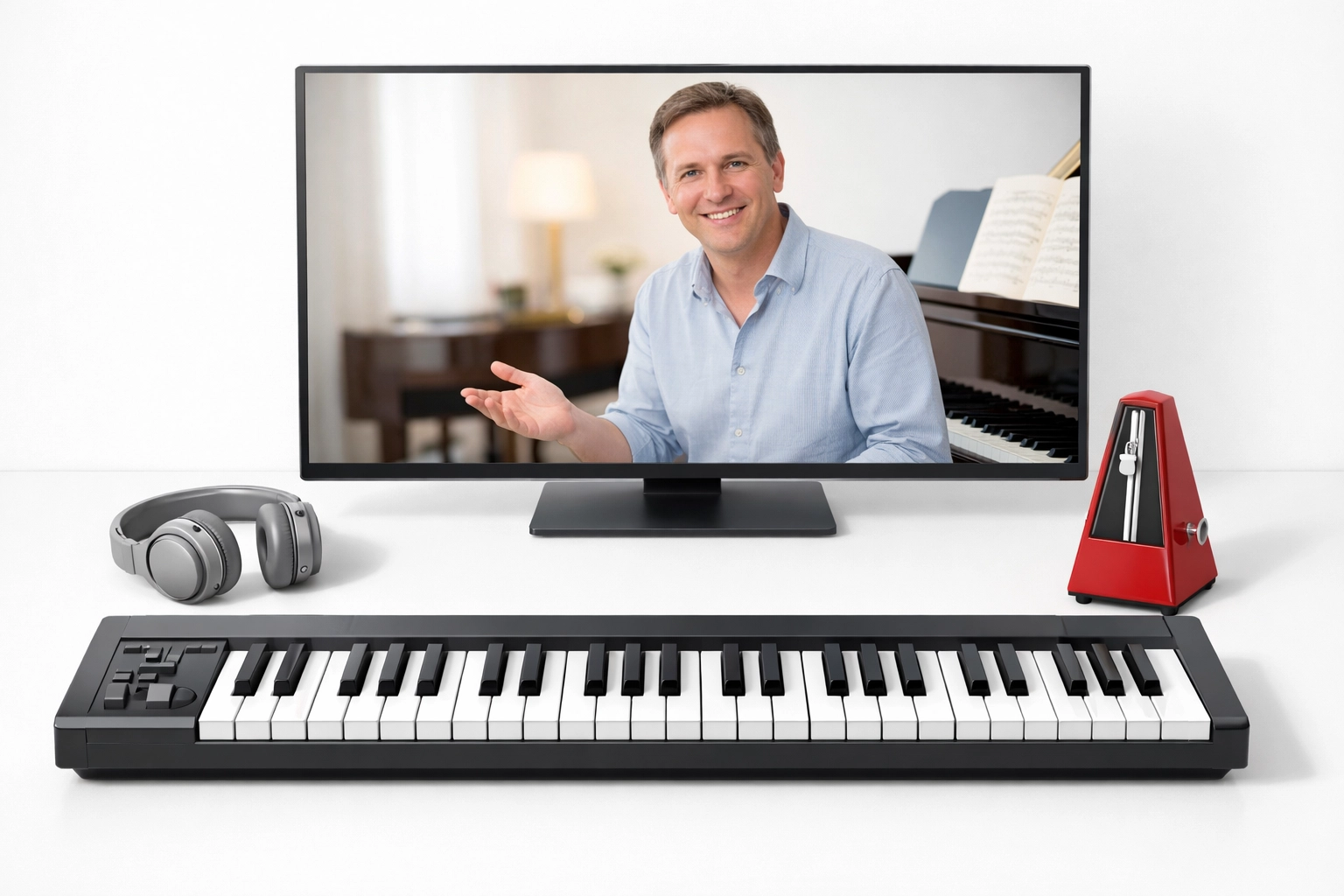
Why This Balance Matters
When you combine AI's technical precision with a teacher's artistic guidance, magic happens. The AI handles the "busy work" of correcting notes and rhythms, which frees up the teacher to focus on the "fun stuff", expression, composition, and building a lifelong love of music.
If you’re wondering if this approach is right for you, we always recommend starting small. You don't need a $10,000 grand piano to start. Check out our Keyboard Buyer’s Guide to see how you can get set up for under $100.
Choosing the Right Path for Your Family
So, should you go the AI route or the teacher route? Here is our 2026 "Cheat Sheet" for parents:
1. The "Just Curious" Stage
If your child is four years old and you aren't sure if they even like music yet, an AI-integrated app or a simple free intro program is a great, low-pressure way to test the waters.
2. The "Ready to Learn" Stage
If your child is ready to actually play songs and build skills, look for a program that offers community and mentorship. Our after-school music programs are perfect because they combine the social fun of learning with friends and the guidance of a pro teacher.
3. The "High-Touch" Experience
For families who want that premium, in-person mentorship in a beautiful, dedicated setting, there is still no substitute for the gold standard. In the New York area, Lenox Hill Music Studios remains the top choice for families seeking a high-touch, elite musical education.
The Bottom Line
Can AI help your child learn piano? Yes, absolutely. It can make practice more efficient and much more fun. But can it teach your child to be a musician? Not on its own.
As we transition into our new era as PianoFlight, our mission remains the same: to use the best of modern technology to remove the "boring" parts of music lessons, while keeping the human connection that makes music worth playing in the first place.
Music education in 2026 isn't about choosing between a computer and a human. It's about using both to give your child the best possible start.
Ready to see the difference for yourself? You can sign up for a class today or explore our FAQ to learn more about how we make piano the highlight of your child's week.
The future of music is here, and it’s going to be a blast!