Why Does My Child Forget a Piano Song They Knew Yesterday?
Quick answer: a beginner who forgets part of a piano song after a day or two has not necessarily lost the skill. Often, the song still depends on a fragile starting cue, a remembered hand shape, or following along from the beginning. A short practice that asks the child to recall one small section—without immediately giving the answer—can make the memory easier to find next time.
The goal is not to test your child or make them prove that yesterday’s practice “worked.” The goal is to help the beginning, middle, and ending become three familiar places they can return to.
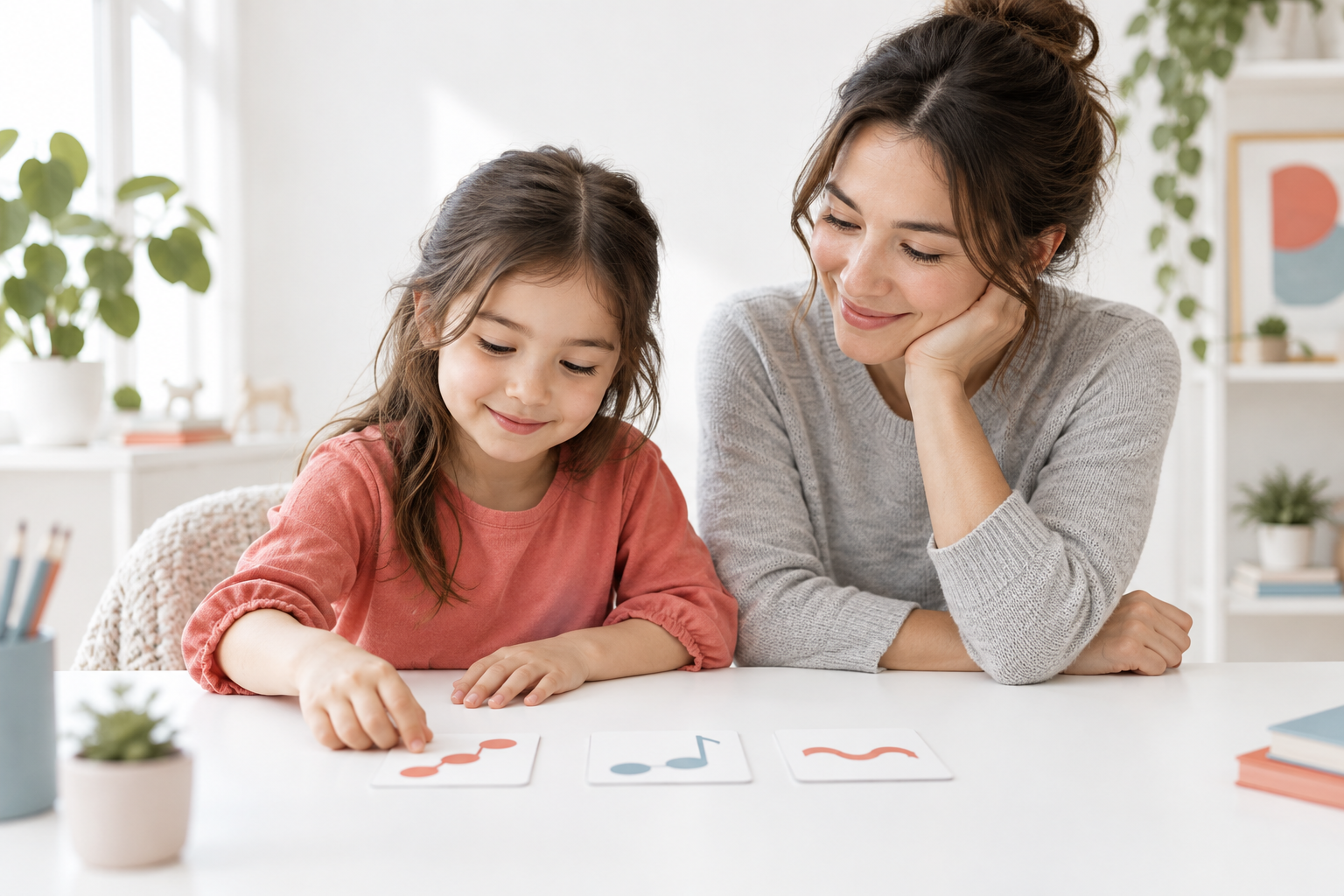
Why does my child forget a piano song after practicing it?
Beginners can play a song correctly one day and feel lost the next because the music is still connected to a narrow set of clues. Your child may remember the motion after someone gives the first note, remember the sound only when the song starts at the beginning, or rely on watching a demonstration instead of finding the pattern independently.
That does not make the earlier success fake. It means the child needs more than one path back into the music.
Listen for the exact place where the memory disappears:
- The first note: your child knows the song once someone helps them begin.
- A transition: the opening is easy, but moving into the next phrase causes a stop.
- The rhythm: the notes look familiar, but the timing has gone missing.
- A hand change: the child remembers one hand position but not where the hand moves next.
- The ending: practice always begins at the top, so the last line gets fewer successful repetitions.
Finding the missing cue is more useful than asking for another full run-through.
Try this six-minute “start, retrieve, reconnect” routine
Choose one small part of the assigned song. Two to four notes, one rhythm pattern, or one short phrase is enough.
- Start with a clue (one minute). Ask your child to name or find the first note, clap the opening rhythm, or point to the place on the page. Use the same kind of clue the teacher used.
- Retrieve without rushing (two minutes). Give your child a quiet moment to try the small section. If they are stuck, offer one smaller clue instead of playing the whole answer.
- Reconnect the phrase (two minutes). Add the notes immediately before or after the remembered section. Play the short connection slowly twice.
- Return from a second starting place (one minute). Begin once from the middle or ending. This helps the song become more than one long chain that only works from the top.
Stop after one clear recovery. A short successful recall is more useful than continuing until the child is tired or upset.
How can a parent help without giving every answer?
You do not need to read music or reteach the lesson. Your best role is to make the next step small and give your child enough time to think.
Use one question at a time
Try: “What is the first clue you remember?” or “Can you tap the rhythm before you play?” Avoid stacking several instructions while your child is searching.
Wait before helping
A few quiet seconds may feel long, but they give your child a chance to find the answer. If you immediately point, name the note, and demonstrate the phrase, the adult becomes the memory cue.
Make the section smaller
If a whole line feels gone, choose the first two or three notes. If those still feel uncertain, clap the rhythm or locate only the starting place.
Notice the recovery
Praise the specific action: “You found the middle without starting over,” or “You remembered the rhythm after one clue.” That tells your child what to repeat next time.
If practice often turns into a parent-child lesson, see how to help your child practice piano without becoming the teacher. If your child restarts after every slip, the guide to building calm restart points can help.
What should you avoid when a song feels forgotten?
- Do not turn yesterday into a test. “You knew this yesterday” adds pressure but does not reveal the missing cue.
- Do not restart the entire song every time. Work near the forgotten spot so the middle and ending also become familiar.
- Do not supply every note name. A small temporary clue can help, but a fully labeled page may keep the child dependent on labels. Read when writing note names helps and when to fade them.
- Do not add many repetitions after success. End with one or two calm, accurate tries and return another day.
When should you ask the piano teacher for help?
Bring the teacher one precise observation: “She can play the opening after I give the first note, but the middle feels unfamiliar the next day.” That is more useful than saying the whole song was forgotten.
Ask which clue your child should use at home: a starting note, finger number, hand position, rhythm words, a short recording, or a marked practice section. Also ask how much of the song should feel independent this week. The answer may be one phrase, not the complete piece.
If the same section stays inaccessible for several practice attempts, your child repeatedly cannot find the starting place, or the assignment causes consistent distress, pause the guessing and ask for a smaller target. The lesson may need a clearer demonstration, an easier step, or a different practice cue.
Build a learning path your child can return to
Memory becomes more dependable when lessons give beginners clear demonstrations, small repeatable goals, and a sequence that connects songs with rhythm, note reading, keyboard geography, and coordination.
Explore iPianoLab online learning for a flexible beginner path your child can revisit at home.
Ready to compare current programs and locations? See iPianoLab signup options.
Frequently asked questions
Is it normal for a beginner to forget a piano song?
Yes. A new song may still depend on a starting clue, demonstration, hand shape, or playing from the beginning. Short recall practice from more than one starting place can help make the song easier to retrieve.
Should my child repeat the whole song until they remember it?
Usually, a smaller target is better. Choose the forgotten transition or a two-to-four-note group, retrieve it slowly, then reconnect it to the phrase around it.
Should I tell my child the first note?
A first-note clue can be useful when that matches the teacher’s plan. After the child succeeds, pause on the next attempt and see whether they can find the clue independently.
How long should a memory-focused piano practice take?
For a young beginner, a focused five or six minutes may be enough for one section. Stop after a clear recovery rather than stretching the exercise into a test.