Should You Write Note Names on Your Child’s Piano Music?
Quick answer: writing a few note names can be a useful temporary clue, but labeling every note usually makes it harder for a child to practice reading music independently. The best middle ground is to mark one or two starting notes, help your child notice whether the melody moves up, down, or repeats, and then remove the extra labels as the pattern becomes familiar.
A page full of letter names can feel reassuring. Your child stops guessing, the song moves again, and practice becomes quieter. But there is an important difference between helping a child get unstuck and replacing the skill they are trying to learn. If the letters become the only thing your child reads, the musical staff remains unfamiliar.
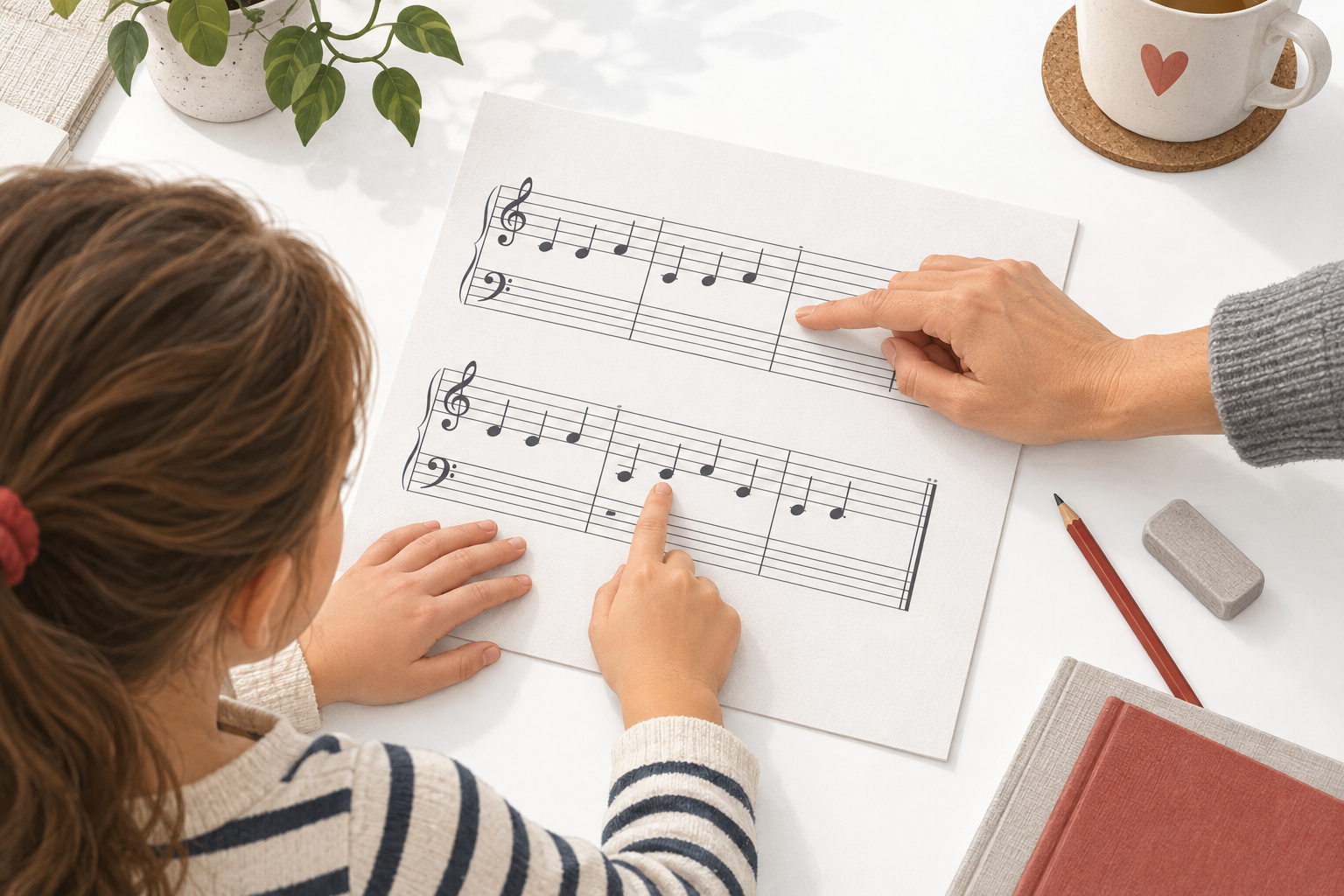
Why do children want note names written above the music?
Beginners are translating several kinds of information at once. They have to notice where a note sits on the staff, find the related key, choose a finger, remember the rhythm, and keep their place in the song. A letter above the note removes one of those decisions. That can be useful for a moment, but it also explains why the shortcut becomes tempting.
The page is asking for too many new decisions
If a song introduces several notes, a new hand position, and an unfamiliar rhythm at the same time, your child may reach for letter names because the whole task feels too large. The better fix may be fewer notes or a shorter section—not more labels.
Your child knows the keyboard better than the staff
Some beginners can quickly find C, D, and E on the keyboard but still need time to connect those keys to symbols on the page. That gap is normal. Music reading develops through many small matches between what the child sees, plays, and hears.
Your child is afraid of a wrong answer
A child who wants every note confirmed may be trying to avoid mistakes rather than build a reading strategy. If that sounds familiar, use a very short example and allow a first try before supplying the answer. The goal is not instant accuracy. It is a repeatable way to recover.
The child is following fingers instead of musical direction
Finger numbers can help organize a beginner hand position, but they do not always tell the child which note is on the page. If your child plays by finger number alone, ask a different question: “Does the next note move up, move down, or stay the same?” That shifts attention back to the written pattern.
When can writing a note name help?
A small written clue can be appropriate when it has a clear job and a plan for disappearing. Useful examples include:
- One starting note: mark the first note of a short section so your child can orient the hand.
- One unfamiliar landmark: identify a note that is new or far outside the child’s usual reading range.
- One repeated trouble spot: add a temporary clue after your child has tried another strategy and still loses the same place.
- A teacher-directed mark: use the exact notation or cue the teacher recommends for that week’s assignment.
The test is simple: does the mark help your child look more closely at the music next time, or does it become the only thing they look at? A good clue points back to the staff. A permanent translation layer pulls attention away from it.
When do written note names start getting in the way?
Labeling is probably doing too much work when your child:
- will not begin a new piece until every note is named;
- reads the letters but ignores whether the notes move up or down;
- loses the rhythm while decoding one letter at a time;
- can play the labeled page but cannot recognize the same notes elsewhere;
- copies a memorized hand pattern without checking the music;
- becomes more anxious when a label is missing.
This does not mean your child is lazy or “bad at reading music.” It means the support has become easier to read than the notation itself. The answer is to make the reading task smaller and more predictable.
If your child is not yet reading words fluently, see our guide to starting piano before a child can read. If the child already plays the song from memory and stops watching the page, our parent guide to memorizing piano music can help you balance memory with reading.
A five-minute routine for fading out note-name labels
Use music your child already has permission to practice, and follow the teacher’s assignment first. This routine is a short reading reset, not a replacement for the lesson plan.
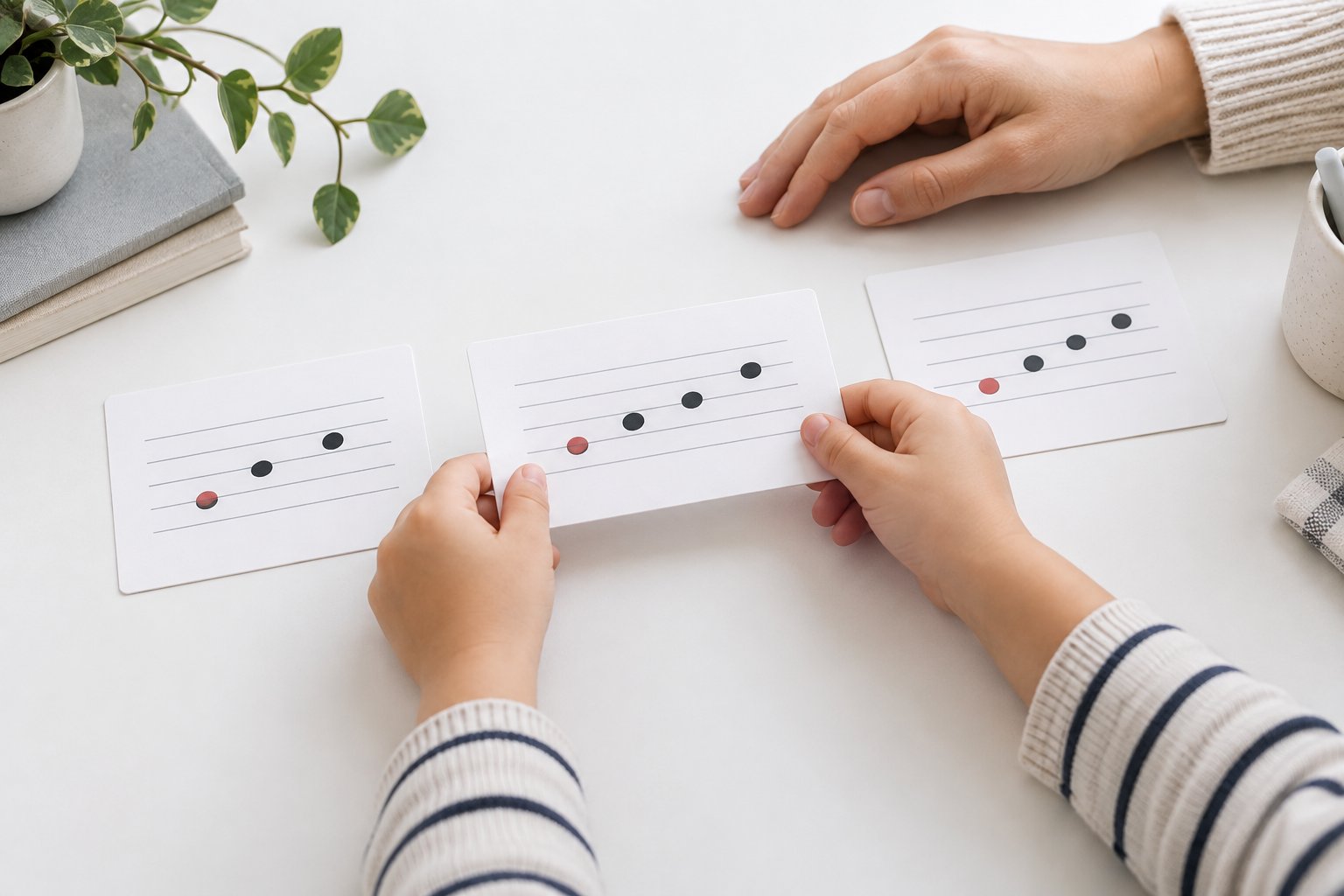
- Choose only three to five notes. Cover the rest of the line with a blank sheet of paper. A smaller visual field makes it easier to see the pattern.
- Find one landmark. Ask your child to identify the first note using a clue the teacher has already taught. If needed, write only that one letter.
- Trace the direction. Without playing, have your child point to each note and say “up,” “down,” or “same.” This builds a visual path before finger choices compete for attention.
- Play once, slowly. Keep the rhythm simple enough that your child can continue looking at the page. Stop after the small group of notes, even if the rest of the song is familiar.
- Hide the written clue. Cover the starting letter and try the same group once more. If your child gets stuck, uncover it briefly, then hide it again.
Finish after one or two successful tries. The purpose is to prove that the clue can fade. Repeating the section until frustration appears teaches less than a short success your child can recreate tomorrow.
Try the “first note plus pattern” rule
For many beginner melodies, your child does not need a separate letter above every note. One starting note plus the direction of the pattern may be enough:
- Start on the marked note.
- Notice whether the next note is higher, lower, or repeated.
- Keep one steady count.
- Pause only at the end of the tiny section.
This approach connects staff reading, keyboard geography, listening, and rhythm. It also gives your child a process that works on a new page—not just an answer for the current song.
What should parents avoid?
- Do not erase the teacher’s marks without asking. A teacher may have added a note name, fingering, bracket, or reminder for a specific reason.
- Do not label the whole page before your child tries it. Give the child a chance to use the strategies they learned in class.
- Do not turn flashcards into a speed test. Fast naming is not the only reading skill. Direction, rhythm, pattern recognition, and listening matter too.
- Do not correct every note from across the room. Constant answers can make your child wait for the next correction instead of checking the page.
- Do not assume one difficult page means a reading problem. The song may simply introduce too much material at once.
Parents can support the practice routine without taking over the lesson. If you are unsure how much help to give, use this guide to help your child practice piano without becoming the teacher.
What should you ask the piano teacher?
Bring one specific example instead of a general concern. You might say:
“My child can play this line after we write every letter, but gets stuck when the letters are covered. Which one or two landmarks should we use, and what should we ask them to notice between those notes?”
That gives the teacher useful information. They can check whether the child needs an easier reading range, fewer notes, a different hand position, more rhythm work, or a clearer connection between the staff and keyboard. They can also tell you which marks to keep and which ones to fade.
If your child relies on one finger even when the page shows a clear pattern, read why beginners sometimes play piano with one finger. The reading question and the fingering question may be related, but they are not always the same problem.
Build music reading through songs and small wins
iPianoLab helps beginners connect songs with keyboard geography, rhythm, note reading, two-hand coordination, and music literacy. Explore the online learning options when your child would benefit from a structured path they can revisit at home.
Frequently asked questions
Is it bad to write note names on sheet music?
Not automatically. One or two temporary note-name clues can help a beginner find a starting point or handle an unfamiliar note. The problem is labeling every note so consistently that the child reads only the letters and stops interpreting the staff.
Should parents put letter stickers on piano keys?
Ask the teacher before adding permanent or long-term labels. Stickers can help with initial orientation, but some children become dependent on them or look for letters instead of learning the repeating keyboard pattern. A temporary, teacher-approved reference may be more useful than labeling every key.
How can my child learn notes without memorizing a saying for every line?
Landmark notes, steps and skips, note direction, and short visual patterns can reduce the need to calculate each note separately. Different teachers use different systems, so ask which landmarks and pattern words match your child’s current materials.
What if my child knows note names but still plays the wrong keys?
Naming a printed note and finding its place on the keyboard are related but separate skills. Slow the task down: identify one starting note, locate it, then follow a very short up-down-same pattern. If the mismatch continues, show the exact example to the teacher.
Should my child read note names or finger numbers?
Both can be useful, but neither should replace the musical pattern. Note names identify pitch; finger numbers organize movement. A child also needs to notice rhythm, direction, repeated notes, and how the music sounds. Follow the teacher’s current priority for the piece.
A calm next step
You do not have to remove every pencil mark tonight. Choose one short line, keep one useful landmark, and help your child see what happens next. When the child can play the pattern, cover the clue and try again. Progress is not a perfectly clean page. It is needing a little less help to understand the next one.
Find the right iPianoLab starting path
Compare current iPianoLab options and choose a beginner path that fits your child’s age, schedule, and need for support.