Why Does My Child Lift Their Shoulders While Playing Piano?
Quick answer: children often lift their shoulders at the piano when the bench is too low or far away, their feet are unsupported, the music feels difficult, or they are trying to make the fingers work by tightening the whole upper body. Do not keep telling your child to “relax.” First improve the setup, choose two or three easy notes, and use a short lift, breathe, release reset before playing again.
Raised shoulders are a signal to investigate, not proof that a child is practicing badly. A beginner is coordinating posture, note reading, rhythm, finger choices, listening, and memory at the same time. When that workload grows, the shoulders may creep toward the ears without the child noticing. The most useful parent response is to make the task smaller and the body better supported.
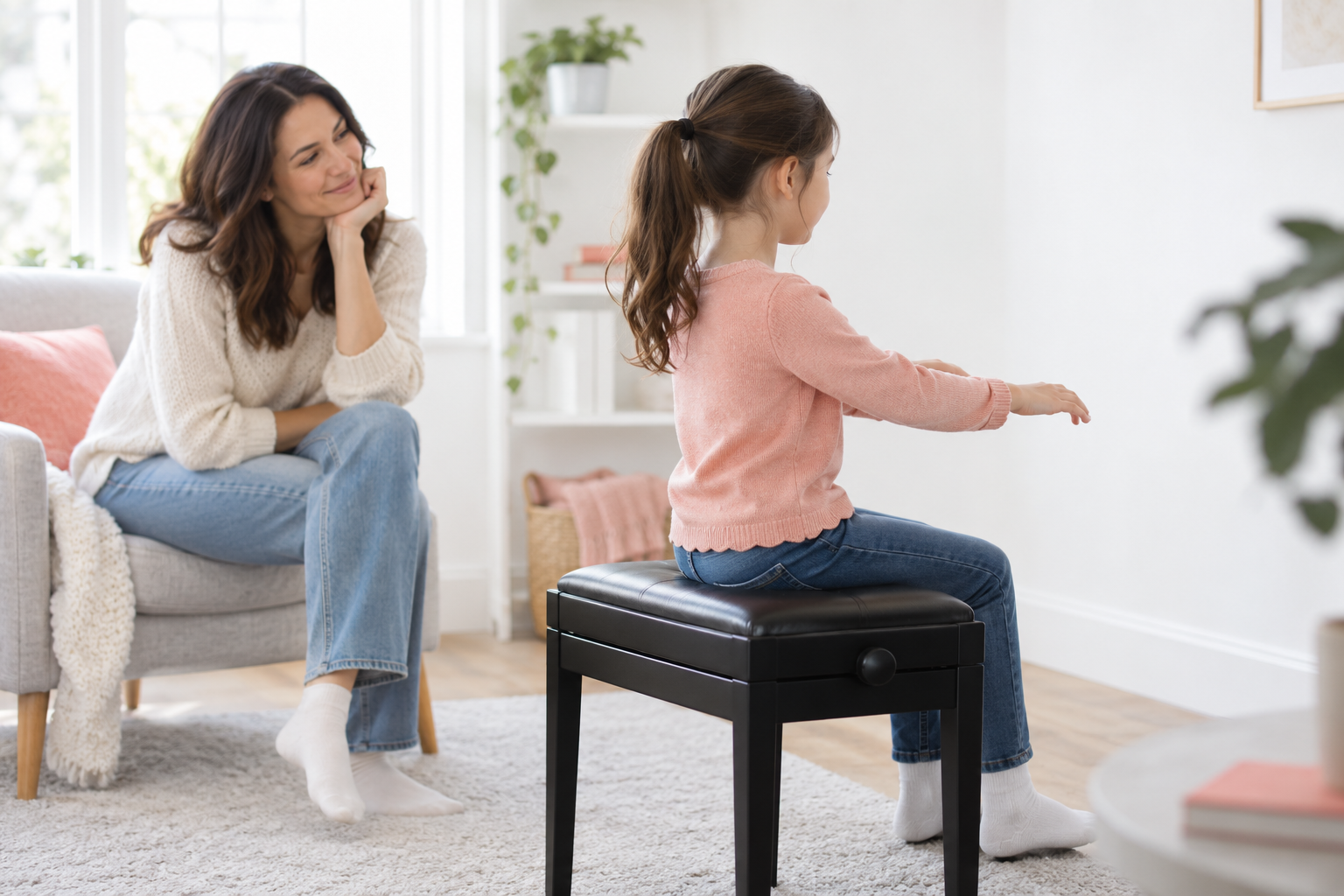
Why do children raise their shoulders at the piano?
A child may lift one or both shoulders for several ordinary reasons:
- The bench height is working against them. If the child sits much too low, the shoulders and elbows may rise to help the hands reach.
- The bench is too far from the instrument. Reaching forward can pull the neck and shoulders into the job.
- The feet are dangling. Without a stable base, a smaller child may brace through the legs, back, or shoulders just to stay balanced.
- The musical task is too large. A difficult measure, a faster tempo, or trying both hands at once can make the whole body tighten.
- The child is trying to play louder. Beginners sometimes lift the shoulders because they think more effort everywhere will create more sound.
- They are concentrating intensely. The shoulders may rise during a tricky passage even when the basic setup is fine.
Look for the pattern rather than correcting the appearance. Do the shoulders rise as soon as the child sits down, only during one measure, when both hands play, or when the tempo increases? That answer helps separate a setup problem from a music-size problem.
What should relaxed piano posture look like for a child?
Relaxed does not mean floppy, perfectly still, or posed for a picture. A comfortable young pianist should be able to breathe, turn the head, move the arms, and shift slightly without losing balance. Useful starting signs include:
- the child sits toward the front half of the bench rather than leaning against the back;
- both feet rest on the floor or a steady foot support;
- the shoulders look soft instead of pulled upward or forced downward;
- the elbows and forearms can move without the child reaching from the neck;
- the wrists are not held in one rigid position; and
- the child can play an easy pattern while breathing normally.
The goal is comfortable movement, not “perfect posture.” A child who sits very straight but holds the breath and freezes every joint is not more relaxed than a child who moves naturally with the music.
A 30-second piano setup check for parents
Before changing how the child plays, check the furniture and distance:
- Support the feet. Use a stable footrest or firm platform if the feet do not reach the floor. It should not slide or wobble.
- Check the bench distance. The child should be able to sit balanced and reach forward without rounding the back or stretching the shoulders.
- Check the height. The forearms should not need a dramatic uphill or downhill angle to reach the playing surface. Ask the teacher about the best adjustment for your child and instrument.
- Remove extra reaching. Put the assigned music where the child can see it without craning the neck.
- Test one easy note group. If the shoulders settle during an easy three-note pattern but rise during the song, the next step is probably a smaller musical task.
If the whole practice area feels awkward, use the home piano practice-space checklist to review lighting, seating, materials, and distractions together.
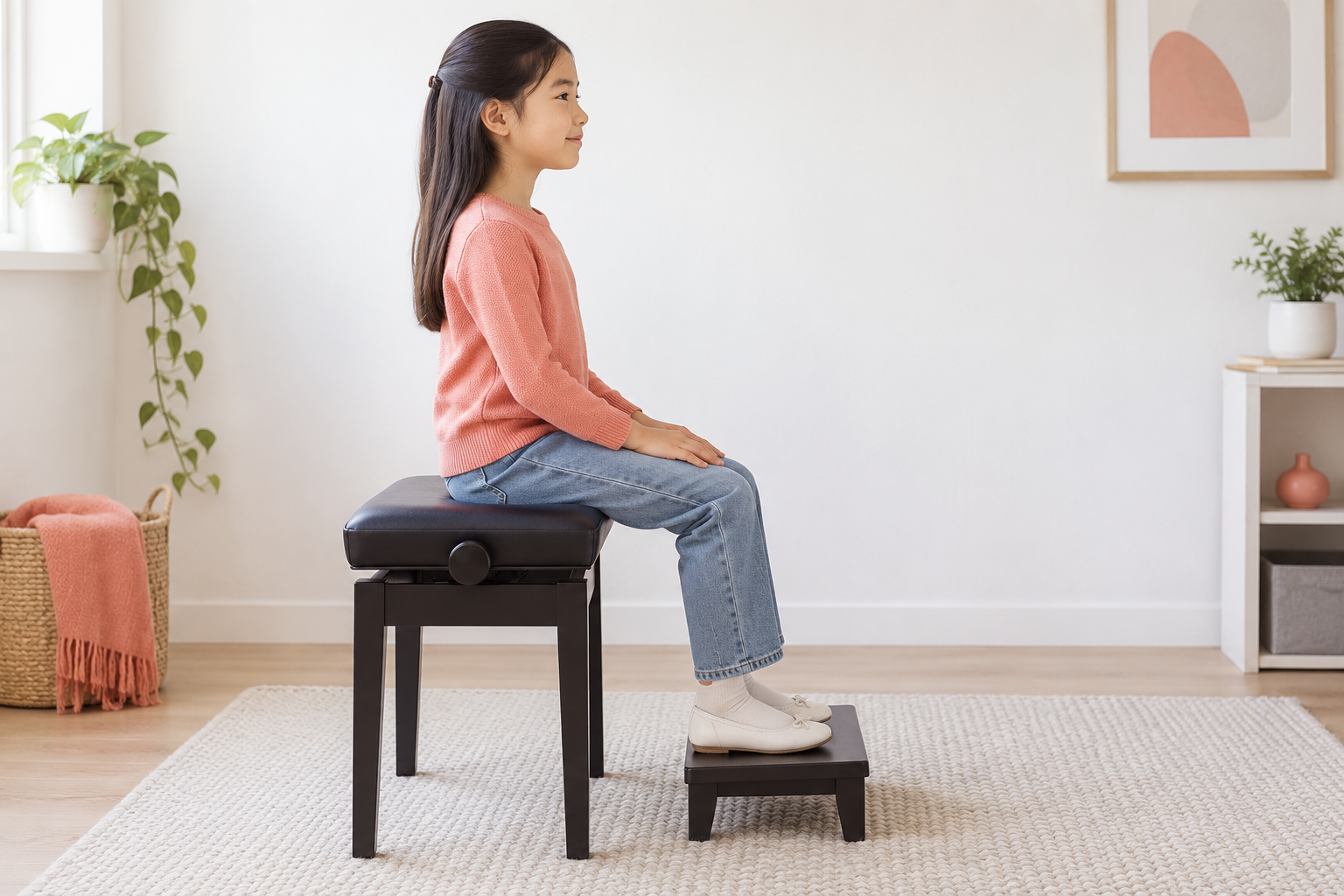
A five-minute “lift, breathe, release” reset
Choose an easy group of two to four notes—something your child already knows. This is a body-awareness reset, not a new technical assignment.
- Sit and support. Place the feet on the floor or footrest and let the hands rest in the lap.
- Lift on purpose. Gently bring both shoulders toward the ears for one second. This makes the tightened position easy to notice.
- Breathe and release. Let the shoulders fall naturally while breathing out. Do not push them down or back.
- Play the tiny group once. Use an easy tempo and stop before the shoulders climb again.
- Notice, do not judge. Ask, “Did your shoulders stay easy, or did they want to help?” Repeat the reset once if needed.
- Reconnect one measure. Put the small group back into the assigned music. If the shoulders rise immediately, slow down or reduce the section again.
Two calm repetitions are more useful than ten tense ones. The child is learning to notice and change the pattern, not to hold a frozen pose through the entire practice session.
What should parents say instead of “Relax your shoulders”?
“Relax” can be hard to follow because it does not tell the child what to do next. Try one specific cue at a time:
- “Put both feet on your support.”
- “Let your hands rest for one breath.”
- “Show me your shoulders up, then let them go.”
- “Let’s play only these three notes.”
- “Can you do that once while breathing normally?”
Avoid stacking cues such as “sit up, curve your fingers, lower your wrists, watch the music, and slow down.” Choose the one change that makes the next attempt easier. If the main concern is the hand rather than the upper body, see what flat fingers mean for a beginner. If the sound is consistently harsh, use the separate guide to playing piano keys too hard.
Should parents push a child’s shoulders down?
No. Do not press on the shoulders or try to hold the child in position. That can create more bracing and does not teach the child how to notice tension independently. Improve the setup, demonstrate the gentle lift-and-release motion away from the instrument, and let the child find an easier position.
If one shoulder repeatedly rises during a particular movement, write down the exact measure or take a short private reference video for the teacher if your family and teacher are comfortable with that. The teacher can check hand position, bench distance, fingering, and the musical task together.
When should you stop and ask for help?
Stop the practice attempt if the child reports pain, numbness, tingling, weakness, or discomfort that does not settle after a short break. Piano practice should not be used to work through pain. Ask the piano teacher to review the setup and movement. For persistent or concerning symptoms, contact an appropriate licensed health professional rather than trying to diagnose the problem at home.
Also ask the teacher for help when the shoulders stay raised during very easy playing, the child cannot sit comfortably even after adjusting the setup, or one side consistently looks and feels different. Bring a specific observation: “The right shoulder lifts in measure six when the hand moves upward,” is more useful than, “The posture looks wrong.”
How this helps a beginner become more independent
The long-term goal is not for a parent to monitor every shoulder movement. It is for the child to notice, reset, and continue. A supportive setup and one simple cue leave more attention available for rhythm, reading, coordination, and listening.
iPianoLab helps beginners play songs early while building those fundamentals in manageable steps. When a musical task is clear and appropriately sized, children can focus on learning instead of fighting the bench, the distance, or an overwhelming passage.
Frequently asked questions
Why does my child shrug while playing piano?
Shrugging often appears when a child is reaching, sitting too low, balancing without foot support, trying to play louder, or concentrating on a difficult passage. Check the setup first, then test a very easy note group to see when the shrug begins.
Should a child’s shoulders stay completely still at the piano?
No. Healthy playing includes movement. Look for shoulders that can remain generally easy and responsive, not shoulders locked into one perfect position.
Can dangling feet affect piano posture?
Yes. A stable foot support can make it easier for a smaller child to balance on the bench without bracing through the upper body. Use a firm, non-sliding support and ask the teacher to check the full setup.
How often should we do the shoulder reset?
Use it briefly when the child first sits down or when you notice tension returning. One or two resets are enough; repeating it constantly can become another distraction.
When is shoulder tension more than a practice issue?
Stop and seek appropriate guidance if the child reports pain, numbness, tingling, weakness, or ongoing discomfort. Ask the teacher to review the setup and contact a licensed health professional for persistent or concerning symptoms.