How to Know If a Piano Teacher Is a Good Fit for Your Child
A piano teacher is a good fit when your child feels safe enough to try, understands what to work on next, and shows small signs of musical progress without dreading every lesson. The best match is not always the strictest teacher, the most entertaining teacher, or the most accomplished performer. It is the teacher whose approach helps this particular child learn, recover from mistakes, and keep moving.
Parents do not need musical training to judge that fit. You can watch how your child enters and leaves the lesson, ask a few useful questions, and look for changes in rhythm, listening, coordination, confidence, and independence. This guide gives you a practical first-month framework.

Quick answer: what does a good child-teacher fit look like?
A good piano lesson should be both welcoming and purposeful. Your child does not have to smile through every difficult moment, but the lesson should feel like a place where effort leads somewhere. A well-matched teacher can adjust an explanation, break a task into a smaller step, and still keep the musical goal clear.
After several lessons, most families should be able to answer yes to these questions:
- Does my child know what they are learning?
- Can my child make a mistake without shutting down?
- Does the teacher notice effort as well as accuracy?
- Do we leave with one or two clear next steps?
- Can I see or hear at least one small area of progress?
One difficult lesson does not automatically mean the match is wrong. New routines, unfamiliar adults, and challenging skills can all create temporary resistance. Look for a pattern across several lessons rather than judging a single day.
Eight signs your child’s piano teacher is a good fit
1. Your child feels comfortable trying before they are sure
Beginners make many uncertain attempts. They may play the wrong note, lose the beat, forget a finger pattern, or need to hear the direction again. A good-fit teacher makes room for those attempts while guiding the child toward a better result.
Watch for a child who is willing to answer, copy a rhythm, try a short pattern, or begin again after an error. Quiet children may participate without being talkative. Energetic children may need movement or shorter activity changes. Comfort does not have one personality, but it usually includes willingness to keep trying.
If your child is slow to warm up, read the parent guide to piano lessons for shy children. A gentle start can still include clear expectations and real progress.
2. The teacher explains one clear goal at a time
A beginner lesson can include rhythm, counting, keyboard geography, note reading, listening, melody, chords, and coordination. Trying to correct all of those at once can overwhelm a new student. A strong teacher chooses the most useful next step and makes it understandable.
Your child might leave knowing, “I am keeping four steady beats,” “I am finding these three notes,” or “I am playing the left hand slowly before adding the right.” The wording does not have to be formal. The important part is that the child can connect the activity to a goal.
3. Feedback is specific, calm, and usable
“Good job” feels encouraging, but it does not tell a child what worked. “You kept the beat all the way through that time” gives the child something to repeat. In the same way, “That was wrong” does not show a beginner how to improve, while “Let’s clap this rhythm once before you play it again” creates a next action.
Listen for feedback that names the successful part, identifies one adjustment, and invites another try. Correction is part of learning piano. The question is whether the correction gives the child a workable path forward.
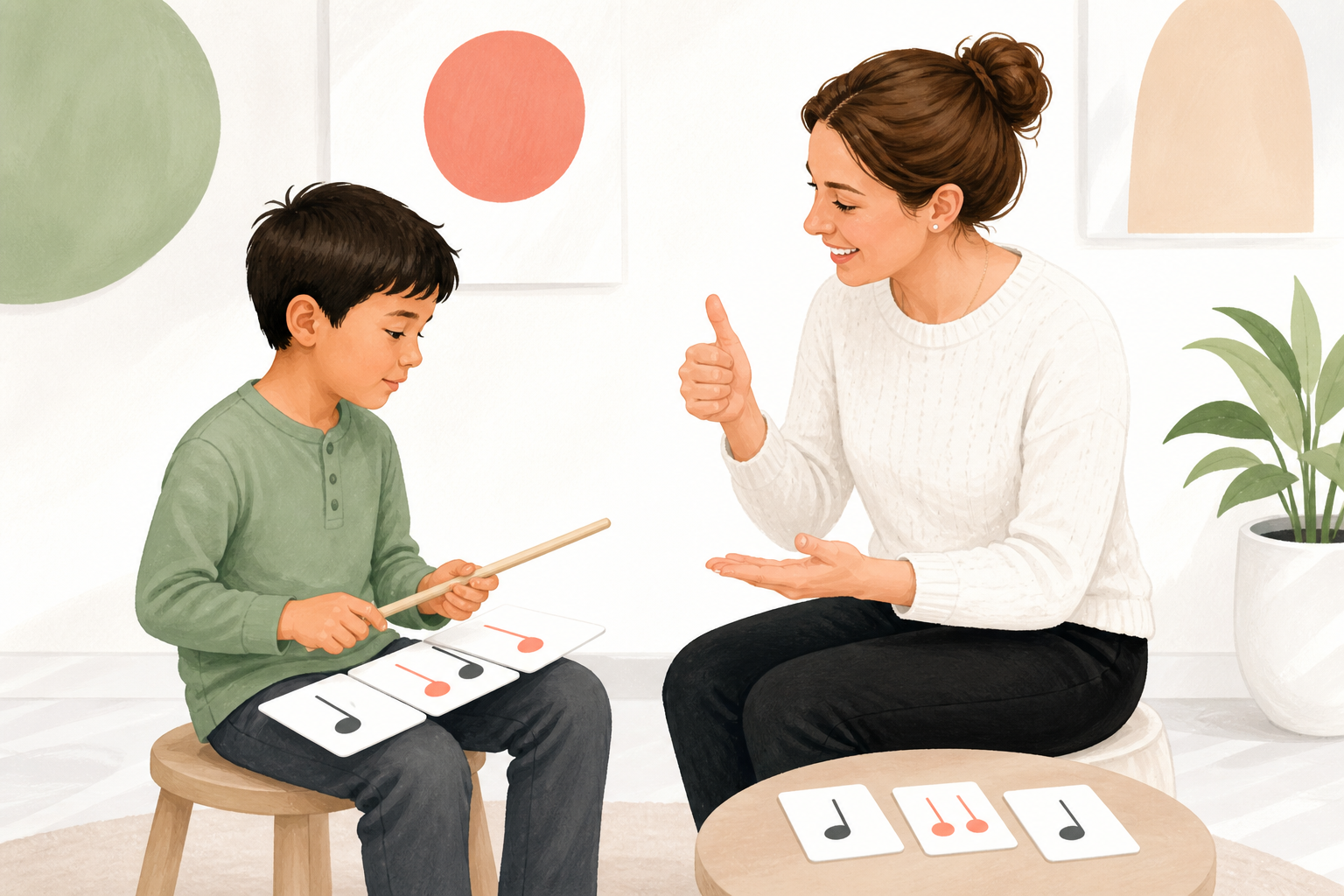
4. The lesson balances early wins with real fundamentals
Children need music that feels worth playing, but they also need the skills that let them become independent. A good beginner path can introduce enjoyable songs early while building counting, rhythm, note recognition, coordination, and music literacy.
Be cautious at either extreme. A lesson made only of drills may lose the child’s sense of purpose. A lesson made only of copying favorite songs without building transferable skills can make future progress fragile. The teacher should be able to explain what the child is learning through the music.
iPianoLab’s approach is to help students play songs they enjoy early, then build the fundamentals that make those wins repeatable. The guide to song-based piano lessons for kids explains how songs and skills can support each other.
5. The teacher adjusts without lowering every expectation
Children do not all process instructions in the same way. One may need to hear a pattern. Another may need to see it demonstrated. Another may need to clap, count aloud, or work in a shorter segment. A well-matched teacher changes the route when the first explanation does not connect.
Adjustment is not the same as removing every challenge. The teacher still helps the child finish a small musical task, understand a correction, or try again. The goal is a challenge that stretches the student without turning every lesson into an endurance test.
6. Your child leaves knowing what to do at home
Home practice becomes much harder when the assignment is vague. “Practice your songs” asks a young beginner to decide what to play, how many times, what to fix, and when to stop. A clearer plan might be: clap the first rhythm twice, play the right-hand section slowly, then finish with the favorite song.
Parents should not have to reconstruct the entire lesson. The child, teacher, or program should provide a short next-step plan that the family can follow. If the plan regularly disappears between lesson and home, ask for a simpler written or demonstrated recap.
7. Communication with the parent is brief but meaningful
A parent does not need a minute-by-minute report. A useful handoff can take two minutes: what the child learned, what to repeat, what to watch, and when to ask for help. This keeps the adult informed without making the parent responsible for teaching the music.
Good communication also works in both directions. You should be able to share a relevant concern—such as practice frustration, schedule pressure, or confusion about the assignment—and receive a practical response. The teacher may not change every element of the program, but the concern should be heard and addressed clearly.
8. Progress is visible in more than one way
Beginner progress is not limited to playing a complete song. Your child may begin to keep a steadier beat, find a note without help, coordinate two short parts, listen more carefully, recover after a mistake, or explain the week’s goal. These are meaningful building blocks.
Ask the teacher what skill is developing now and what the next checkpoint will be. A clear answer helps you distinguish a normal learning plateau from a lesson path that is not working.
Good challenge or poor fit? Use this comparison
| What you notice | Often a normal challenge | Worth a conversation |
|---|---|---|
| Frustration | Your child struggles, accepts help, and can try again | Your child regularly freezes, cries, or expects humiliation after mistakes |
| Practice | Some reminders are needed, but the assignment is understandable | No one can explain what should happen between lessons |
| Feedback | The teacher corrects errors and shows a specific next step | Feedback is mostly vague praise, impatience, or criticism without a solution |
| Pacing | Some skills need repetition before the child moves on | The work is constantly far too easy or so difficult that participation stops |
| Communication | The teacher gives a concise recap and responds to practical questions | Important concerns are repeatedly dismissed or left unclear |
| Progress | Growth is uneven, but small skills improve across several weeks | No current goal, checkpoint, or change can be identified after a fair trial |
Questions to ask after the first few piano lessons
A good conversation is usually more useful than silently guessing. Ask questions that invite a specific answer:
- What is my child learning right now?
- What is one small thing we should repeat at home?
- What should I do if my child gets stuck?
- How do you decide when a beginner is ready to move forward?
- What kind of progress should we look for during the next few weeks?
- Is there anything about the lesson format or routine that we should adjust?
Notice whether the answers are understandable and connected to your child. A teacher may not predict an exact timeline, because children learn at different rates. They should still be able to name the present goal and a reasonable next checkpoint.
What should your child be able to tell you?
Children often reveal lesson fit in simple comments. Instead of asking only, “Did you have fun?” try questions that make room for a more useful answer:
- What was the easiest part today?
- What felt tricky?
- What did your teacher help you change?
- What do you want to show me?
- What will you try first next time?
A child does not need to describe music in adult language. “We clapped it first,” “I can find the starting note,” or “I have to slow down here” may show that the lesson gave them a clear learning tool.
How long should you give a new piano teacher?
Give the relationship enough time for the teacher and child to learn each other’s pace, unless there is a safety or respect concern that needs immediate action. For many beginners, several lessons or a short defined level gives a better picture than the first meeting alone.
During that period, track four things:
- Comfort: Is your child becoming more willing to participate?
- Clarity: Do lesson and practice goals make more sense?
- Connection: Does the teacher respond to how your child learns?
- Progress: Is at least one musical skill becoming steadier or more independent?
iPianoLab levels are organized in six-lesson blocks, which can provide a practical review point. A checkpoint does not require dramatic progress. It simply creates a moment to ask what changed, what still needs repetition, and whether the format continues to fit.
When should you consider a different lesson format?
Sometimes the teacher is capable and caring, but the format is not right for the child. A student who becomes self-conscious in a private lesson may gain energy from learning near peers. A child who is distracted in a group may need more individual attention. A busy family may benefit from online lessons that can be revisited between scheduled support.
Compare the options by the child’s needs rather than assuming one format is always best. The group versus private piano lesson guide covers pace, feedback, social learning, and schedule. Families considering flexible home learning can also review iPianoLab online learning.
A first-month piano teacher fit checklist
Use this checklist after the first few lessons. You do not need every box to be perfect, but the overall direction should be encouraging.
- The child is willing to attempt unfamiliar music.
- The teacher can name the current learning goal.
- Corrections include a clear next action.
- The lesson includes both musical enjoyment and skill-building.
- The teacher changes an explanation when the first approach does not work.
- The home practice plan is short and understandable.
- The parent knows when and how to ask for help.
- At least one small musical skill is becoming more independent.
- The child’s confidence is stable or growing, even when the work is challenging.
Frequently asked questions
Should a good piano teacher make every lesson fun?
A good lesson should be engaging and respectful, but not every minute will feel easy or entertaining. Learning music includes repetition and correction. The important question is whether challenge stays purposeful and whether the child receives the support needed to continue.
What if my child likes the teacher but does not practice?
Separate relationship fit from routine clarity. Ask whether the child understands the assignment, whether the task is small enough to begin, and whether the practice time fits the family’s week. A warm teacher relationship helps, but the home plan still needs to be specific.
What if my child is quiet during lessons?
Quiet participation is not automatically a problem. Look for eye contact when comfortable, listening, imitation, attempts, questions in the child’s own style, and growing willingness to play. Ask the teacher how they are building trust and checking understanding.
How do I know whether the teacher is teaching real skills?
Ask what musical idea is being developed and how it will connect to the next level. Real beginner skills may include steady beat, counting, note recognition, keyboard geography, hand coordination, melody, chords, listening, and music reading. The teacher should be able to name the connection.
When should I switch piano teachers?
Consider a change when there is a continuing pattern of poor communication, unclear goals, unusable feedback, a pacing mismatch that is not improving, or a child who regularly feels unsafe or defeated. When the concern is not urgent, discuss it first and agree on a short, observable adjustment before deciding.