How High Should a Piano Bench Be for a Child?
A child’s piano bench is at a useful height when the shoulders can stay relaxed, the elbows are roughly level with or slightly above the key surface, and the forearms can reach the keyboard without tilting steeply up or down. There is no single correct bench height in inches for every child. The right setting depends on the child, the instrument, and the height of the keyboard.
Feet matter too. If your child’s feet do not reach the floor, give them a firm, non-slip foot support rather than asking them to balance with dangling legs. A stable seat and supported feet make it easier to move the arms freely and focus on the music.
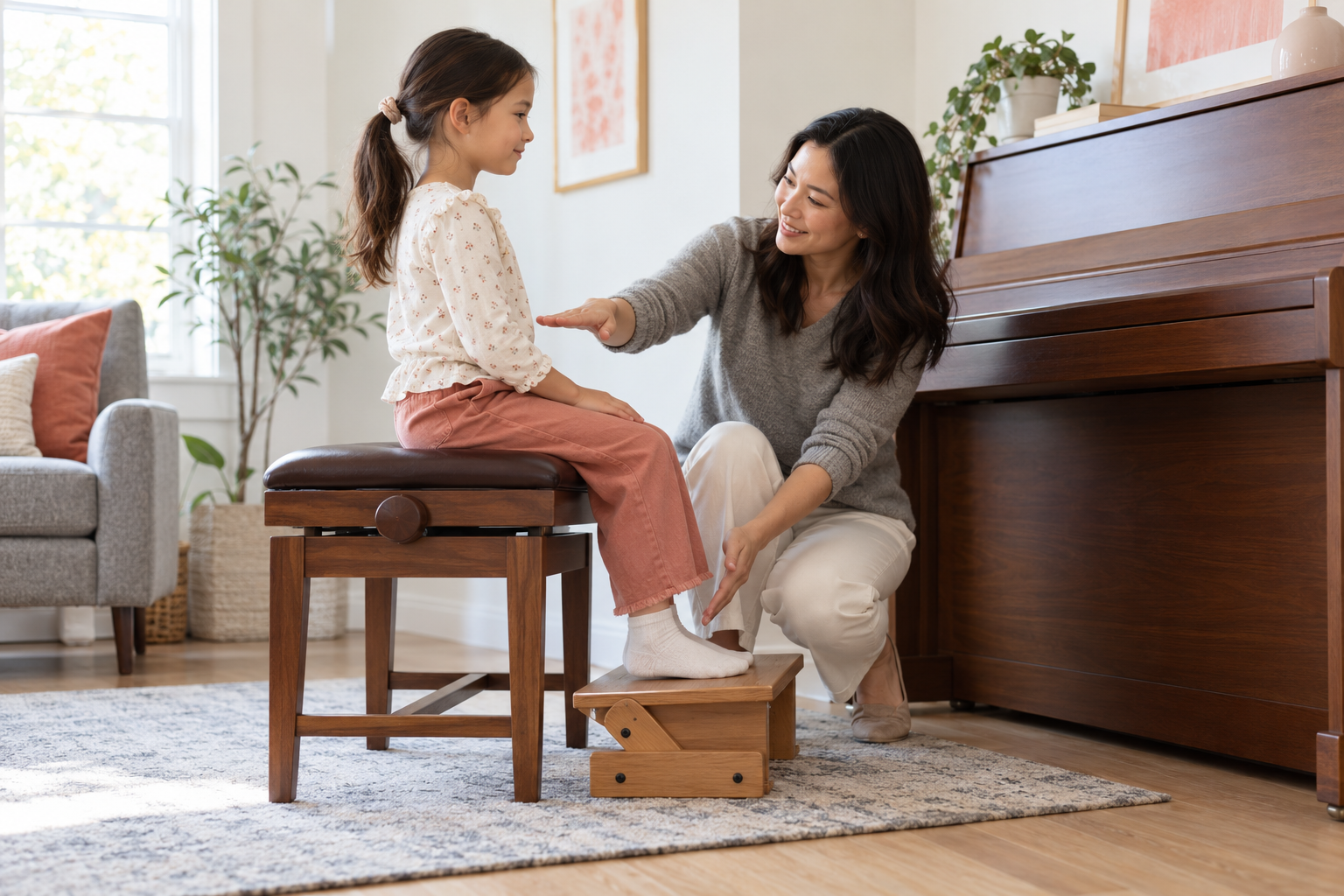
Three checks for the right piano bench height
Use these three checks while your child sits as they normally would to play. Make one small adjustment at a time. The goal is a balanced position that feels easy, not a stiff pose the child must hold.
1. Check the elbows and forearms
Ask your child to place relaxed hands on the keys without pressing down. From the side, the elbows should be around the height of the key surface or a little higher, with the forearms close to level. The wrists should not have to bend sharply up or hang far below the hands.
This is more useful than choosing a bench setting by age. Two children of the same age may have different torso lengths, arm lengths, and instruments. Yamaha’s guidance for teaching basic piano technique also emphasizes adjusting height and distance for young, growing students rather than relying on one permanent position.
2. Check the shoulders
The child should be able to reach the keys without lifting the shoulders toward the ears or leaning the whole body forward. Ask for one slow shoulder roll, then let the arms return to the keyboard. If the shoulders immediately rise again, the bench may be too low, too far away, or both.
Shoulder tension can have several causes, so bench height is not the only answer. If the setup looks reasonable but the shoulders keep lifting at one difficult passage, see why children lift their shoulders while playing piano for a separate musical check.
3. Check the feet and seat
Your child should sit securely on the front half of the bench with enough seat underneath them to feel stable. Their feet should rest flat on the floor or on a solid foot support. Dangling feet can make a small child slide, hook their legs around the bench, or use extra upper-body effort to feel steady.
Do not move the bench so close that the knees are crowded under the keyboard. Do not move it so far away that the child reaches with straight elbows. A comfortable distance leaves room for the arms to move while the body stays upright and balanced.
How can you tell if the bench is too high or too low?
Look at the whole setup rather than one joint. The table below gives useful clues, but treat them as observations to share with the teacher—not a diagnosis.
| What you notice | What it may mean | Try this first |
|---|---|---|
| Shoulders lift and elbows sit well below the keys | The bench may be too low or too far away | Raise the bench slightly, then recheck distance |
| Wrists drop sharply and elbows feel unusually high | The bench may be too high | Lower it one small step and let the hands rest again |
| The child leans forward to reach | The bench may be too far away, too low, or both | Adjust distance before making a large height change |
| Feet swing, hook around the bench, or search for the floor | The child needs stable foot support | Add a firm non-slip platform under both feet |
| Knees hit the stand or keyboard base | The instrument or bench relationship needs adjustment | Check stand height, bench height, and legroom together |
If the child presses the keys with unnecessary force even after the setup feels stable, bench height may not be the main issue. Use the listening steps in Why Does My Child Press Piano Keys Too Hard? and ask the teacher what kind of touch the music needs.
A 60-second piano bench setup for parents
Run this quick check after moving the instrument, changing the stand, sharing the setup with an adult, or noticing a growth spurt.
- Sit naturally. Have your child sit on the front half of the bench without posing or pulling the shoulders back.
- Place relaxed hands. Let the fingertips rest on the keys without playing. Look from the side at the elbows, forearms, and wrists.
- Adjust one thing. Change the bench height a little, then check again. Avoid changing height, distance, and foot support all at once.
- Play an easy phrase. Ask for familiar music, then watch whether the shoulders stay loose and the body remains steady.
Take a quick side-view photo for your own reference if that helps you remember the teacher-approved setup. Keep it private and update it as your child grows. A setup that worked at the start of the school year may need a small change later.
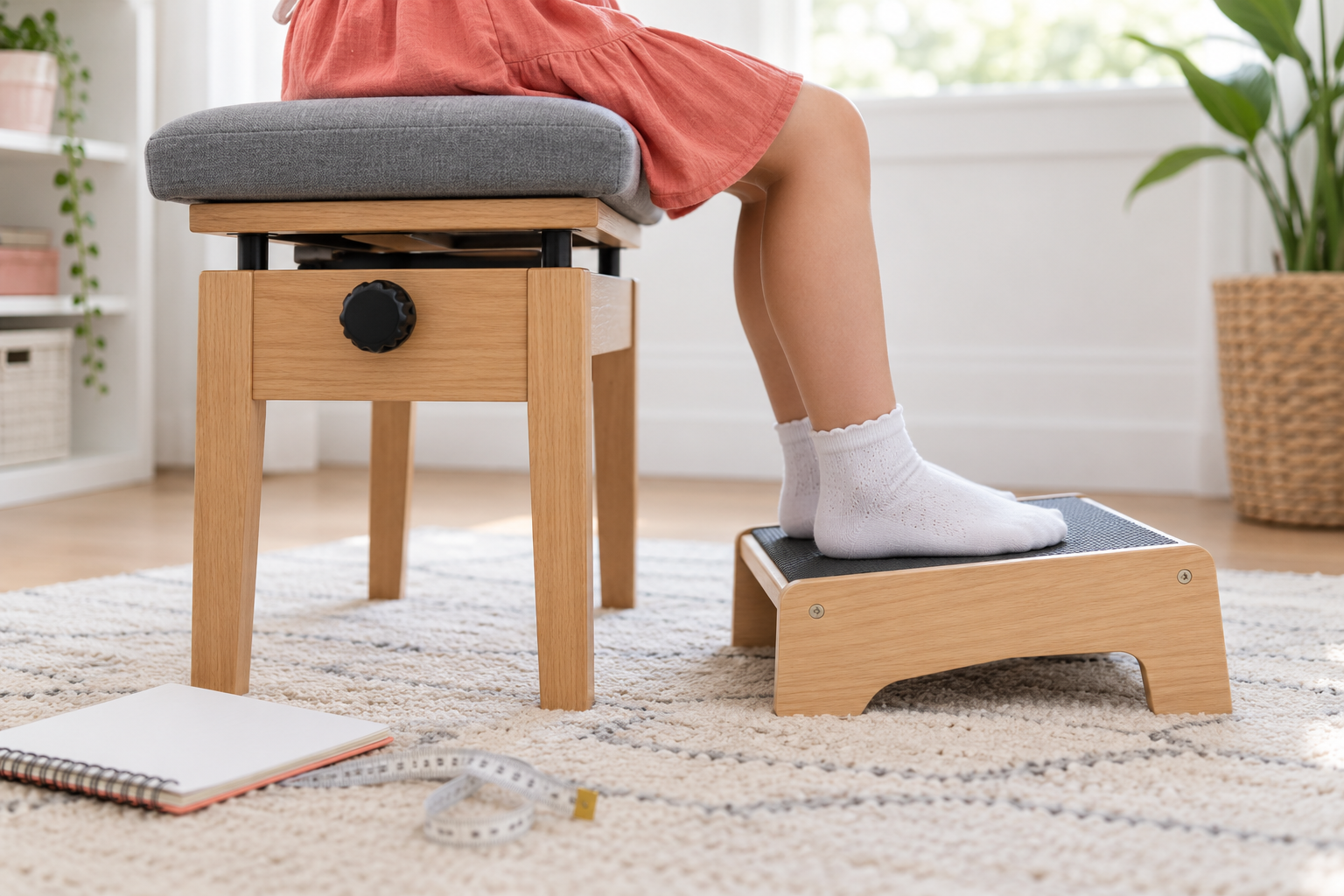
What should you use when a child’s feet do not reach the floor?
Choose a stable platform that supports both feet, has a non-slip surface, and will not tip or slide during practice. A purpose-built adjustable footrest can work well, but the important qualities are firmness, width, and stability—not a particular brand.
Avoid unstable stacks, rolling storage bins, soft cushions under the feet, or anything that rocks when the child shifts weight. If you use a household step temporarily, test it with an adult before the child plays and make sure it cannot slip on the floor.
A soft cushion on top of a bench is not the same as a height-adjustable seat. Thick, squishy cushions can compress or shift, changing the child’s position during practice. Ask the teacher before improvising a large height increase.
What changes with a digital keyboard?
With an acoustic piano, the keyboard height is fixed, so the bench does most of the adjusting. With a portable digital keyboard, both the stand and the bench may move. Set the instrument on a stable stand first, leaving safe knee room, and then adjust the bench to the child.
If the stand is extremely high, raising the bench alone can leave the child’s feet far from the floor. If the stand is extremely low, lowering the bench can crowd the knees. Treat the stand, seat, and foot support as one system.
Families starting with a digital instrument can use our keyboard buying guide for parents and home piano practice-space guide to plan a stable, distraction-light setup.
How often should you recheck the bench?
Recheck whenever the child grows, the bench or instrument moves, another family member changes the setting, or posture suddenly looks different. You do not need to measure before every practice session. A quick visual check and one comfortable warm-up are usually enough.
For an adjustable bench, consider placing a small removable mark at the teacher-approved setting so the family can restore it after an adult plays. Do not put permanent labels on shared or rented equipment without permission.
What should you ask the piano teacher?
Bring a short, specific observation:
“At home, the elbows look a little below the keys and the feet do not reach the floor. Can you show us the position you want and whether we should raise the bench, add foot support, or adjust both?”
For online lessons, place the camera far enough to show the child’s upper body, bench, and feet for a brief setup check. Our online piano lesson setup checklist covers camera placement, sound, materials, and the practice area.
An experienced teacher can also tell the difference between a setup problem and a musical challenge that appears only in one passage. That keeps parents from making repeated furniture changes when the child really needs slower practice, clearer fingering, or an easier coordination step.
Start with a learning setup that fits your child
iPianoLab helps beginners learn songs they enjoy while building note reading, rhythm, coordination, listening, and dependable practice habits through a structured path.
Explore iPianoLab online learning for a flexible home option, or find an iPianoLab beginner path for your child.
Frequently asked questions
What is the correct piano bench height for a child?
There is no universal number. Adjust the seat so the child can keep relaxed shoulders, place the elbows around key height or slightly above it, and reach with forearms close to level. Support both feet on the floor or a stable platform.
Should a child’s elbows be above the piano keys?
The elbows can be roughly level with or a little above the key surface. They should not sit far below the keys or force the wrists into an extreme angle. Ask the child’s teacher to confirm the position for that student and instrument.
Is it okay if a child’s feet dangle at the piano?
A brief moment is not an emergency, but regular practice is more stable when both feet have firm support. Use a wide, non-slip foot platform if the floor is out of reach.
Can I use a cushion to raise my child on the piano bench?
A thin, firm pad may help with a very small adjustment, but soft or shifting cushions can make the seat less stable. An adjustable bench is easier to set consistently. Ask the teacher before making a large improvised change.
How far should the piano bench be from the keyboard?
Close enough that the child can reach with relaxed, slightly bent arms, but far enough to leave comfortable knee room and freedom to move. If the child leans forward or locks the elbows, recheck the distance.
Do growing children need an adjustable piano bench?
An adjustable bench is helpful because the setting can change as a child grows and when family members share the instrument. A fixed bench can still work if the child reaches a balanced position with safe, firm support.
Technique reference: Yamaha Music, “Fix It: Tips for Teaching Basic Piano Technique”.