What Should a Child Do If They Forget Their Piano Song During a Recital?
The short answer: pause, keep the hands still, take one easy breath, and restart from a practiced landmark—not necessarily from the beginning. If the next note still does not come, the child can look to the teacher for help, move to a later section, or finish with a calm bow. A memory slip is a normal performance problem to prepare for, not proof that the child did not learn the song.
Forgetting a piano piece in front of an audience can feel enormous to a young performer. Parents can make it smaller by giving the child a simple recovery plan before recital day. The goal is not a perfect performance. The goal is for the child to know what to do next when the music does not go as planned.
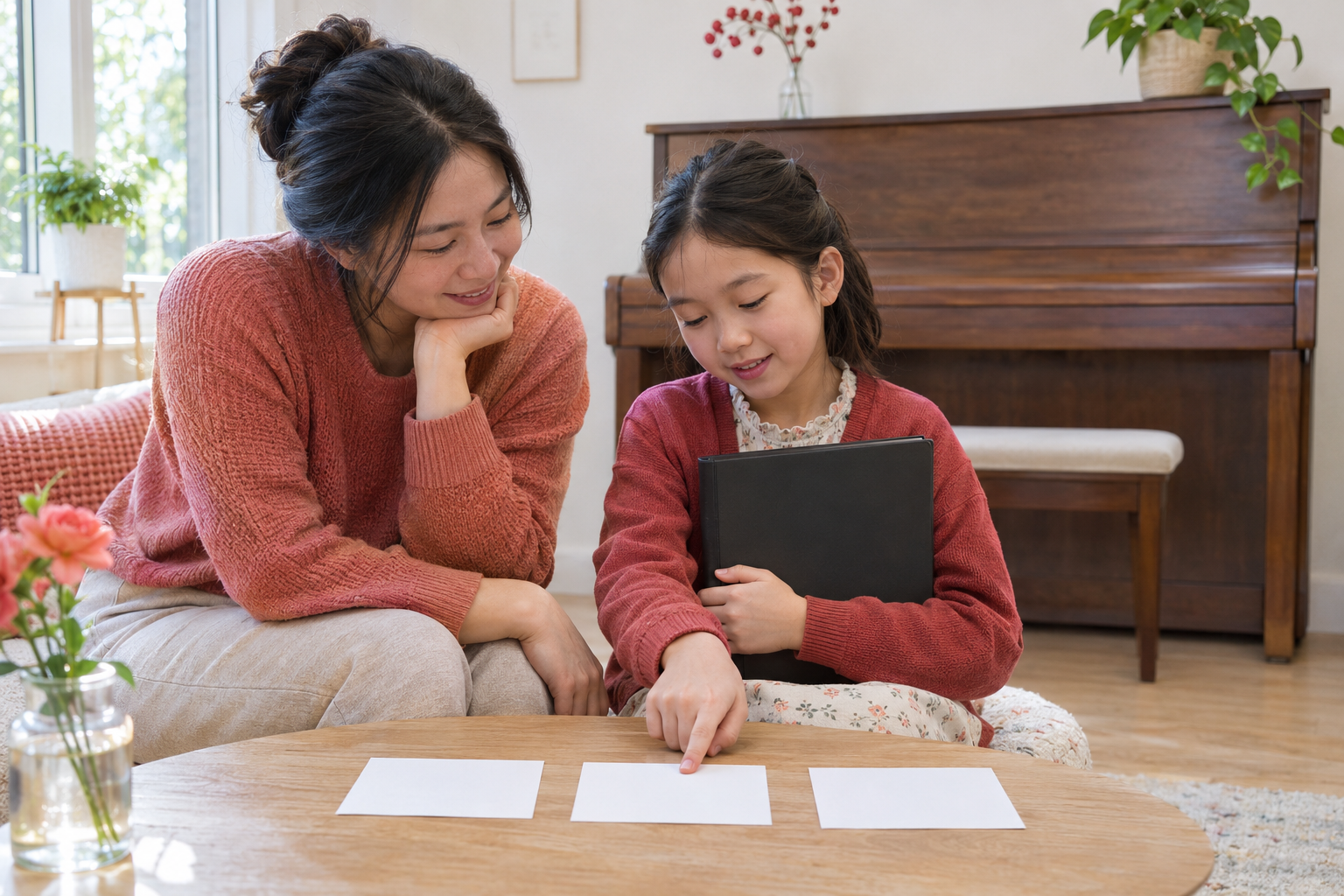
Teach three steps: pause, restart, continue
A child does not need a long speech to remember onstage. Three small actions are enough:
- Pause. Stop moving, let the last sound fade, and take one easy breath. A short silence usually feels longer to the performer than it does to the audience.
- Restart. Go to the nearest practiced landmark: the beginning of the phrase, the start of a new section, a repeated pattern, or another point chosen with the teacher.
- Continue. Resume at a comfortable tempo. Do not rush to “make up” for the pause.
If the restart does not work after one calm try, the child can use the backup plan agreed on with the teacher. That may mean trying a later landmark, glancing at the music if it is available, accepting a quiet prompt, or ending the performance politely. The exact backup should match the recital rules and the child’s lesson plan.
| What happens | Helpful next move | What to avoid |
|---|---|---|
| The child loses one note but knows the phrase | Keep the beat and move to the next familiar note or pattern | Stopping to correct every note |
| The child loses the whole place | Pause and restart at the nearest landmark | Starting from the beginning automatically |
| The restart fails | Use the teacher-approved backup once | Repeating the same failed opening again and again |
| The child cannot continue | Finish calmly, acknowledge the audience, and talk with the teacher later | Apologizing to the audience or explaining the mistake onstage |
Choose restart points before recital day
A restart point is a place the child can find without replaying everything that came before it. Strong restart points are easy to describe and easy to hear. Depending on the piece, a teacher might choose:
- the beginning of each phrase;
- the start of a repeated section;
- a clear change in hand position;
- a new chord pattern or melody;
- the beginning of the final section.
Mark two or three landmarks in the music during practice, using the teacher’s preferred method. Then ask the child to begin from each one. A student who can only begin at the first measure may know the sequence well but still have no way back in after a memory slip.
This is also why restarting the entire song after every home-practice mistake can make recovery harder. Our guide to helping a child stop restarting a piano song after every mistake explains how to practice the small spot and return to the phrase instead.
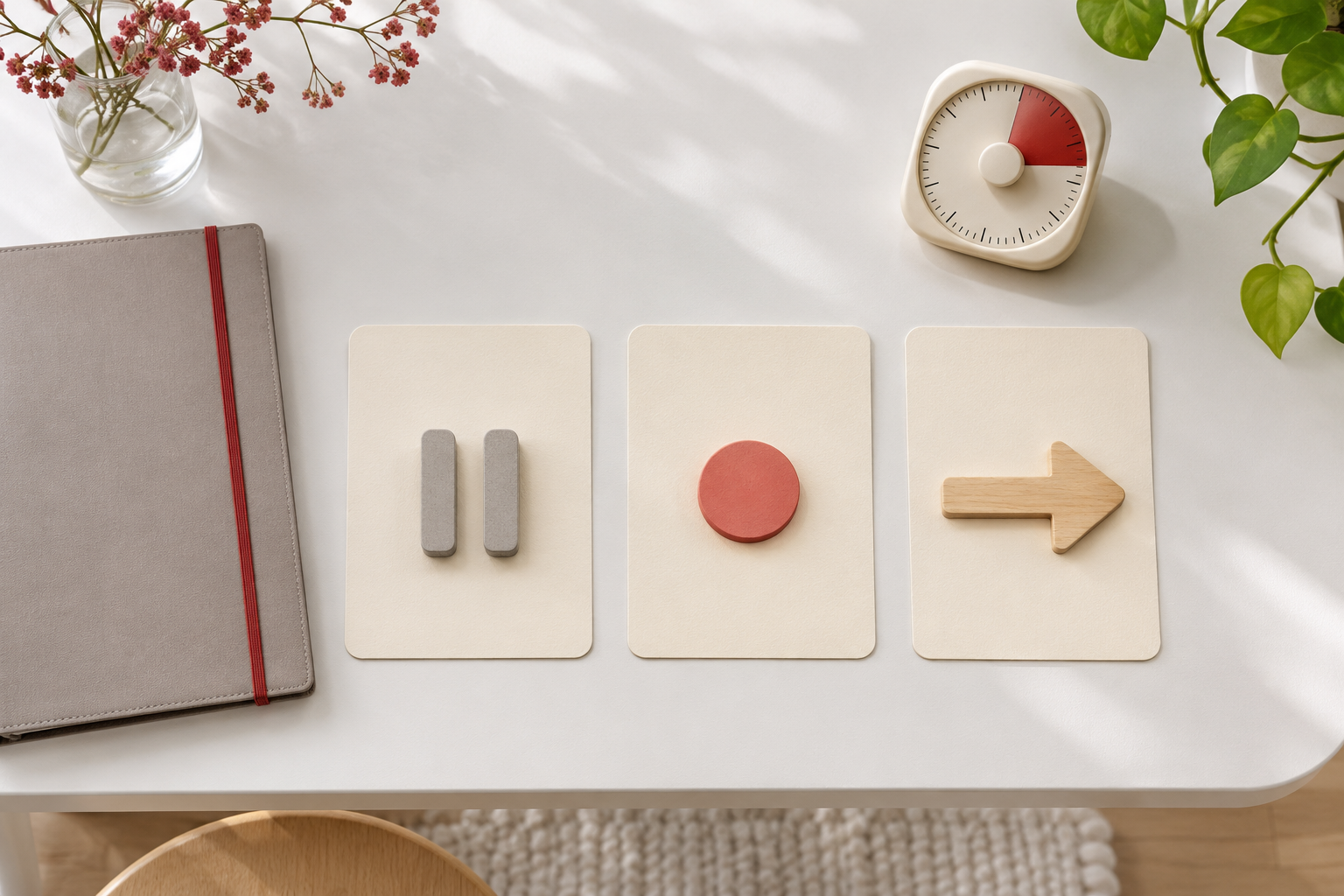
Try this five-minute recital recovery practice
Use this routine once or twice during the week before a performance. It should feel like a game, not a test.
- Name the landmarks. Ask the child to point to two or three places where they can restart.
- Begin in the middle. Start from each landmark without playing the opening first.
- Create one planned pause. At a chosen place, stop on purpose, take one breath, and restart from the nearest landmark.
- Add a small distraction. Have a parent quietly shift in a chair or let a timer sound before the child starts. Keep it gentle and predictable.
- Finish with one complete performance. Let small mistakes pass unless the child truly loses the place.
One recovery rehearsal is useful. Repeatedly interrupting the child to create failures is not. The child still needs chances to experience the piece as a whole and build a sense of flow.
If the piece is still changing from one day to the next, focus first on learning small sections and joining them. See our guide on how long it can take a child to learn one piano song for a practical find–connect–share timeline.
Should a child memorize the recital piece?
Not every recital requires memorization. Some children perform with sheet music; others play from memory; some use a mix. Follow the teacher’s direction and the event rules. If the child will play from memory, practice the music in more than one way: start from landmarks, name the shape of each section, listen for where the harmony or melody changes, and rehearse one calm recovery.
If the score will be on the stand, the child should still practice finding the correct measure after a pause. The music is helpful only if the student knows where to look.
What parents can say before the recital
Use short, specific language that gives the child a plan without predicting a mistake:
- “If you lose your place, pause and use one of your landmarks.”
- “You do not need to rush after a pause.”
- “Your job is to share the music, not prove that you never make a mistake.”
- “If you need help, look at your teacher.”
Avoid last-minute instructions such as “Do not forget the middle,” “Do not mess up,” or “Everyone is watching.” Those phrases give the child a problem but no action.
For a wider recital-day checklist—including arriving, sitting, bowing, and keeping the experience low-pressure—read our first piano recital guide for parents.
What to say after a memory slip
Start with what the child did, not with a technical review:
- “You paused and found a place to continue.”
- “You stayed at the piano even when the plan changed.”
- “I liked hearing you share your song.”
If the child could not continue, keep the first response warm and brief. Detailed problem-solving can wait until the child and teacher are ready. One difficult recital does not define the student’s progress or decide whether they belong in music.
Build the skill between performances
Recovery grows from ordinary practice habits: playing small sections, beginning from different places, keeping a steady pulse, and continuing after a harmless wrong note. Short, consistent practice usually supports these skills better than one long session right before the event. Parents can use our guide to how long a child should practice piano each day to shape a realistic routine.
iPianoLab helps beginning students build songs in clear steps while strengthening rhythm, note reading, keyboard geography, coordination, and musical confidence. Families can explore online piano learning with iPianoLab or find an iPianoLab lesson option.
Frequently asked questions
Should my child start the whole piano piece over after forgetting?
Usually, no. Restarting at the nearest practiced landmark is faster and teaches a more useful performance skill. The teacher may choose a different plan for a very short piece.
How long should a child pause during a recital?
Long enough to stop guessing and choose the next action. One easy breath is a helpful cue. The child does not need to count the seconds.
Can a parent call out the next note from the audience?
Follow the teacher’s plan. An unexpected call from the audience may make it harder for the child to recover. It is usually better for the child to look to the teacher or accompanist if help is needed.
Does forgetting mean the piece was not ready?
Not necessarily. A child can know a piece and still lose the sequence under performance pressure. Readiness includes learning the music, starting from landmarks, and knowing what to do after a pause.
What if my child wants to skip the recital after a memory slip?
Listen first and involve the teacher. A smaller next step—playing for one trusted person, performing a shorter piece, or participating without memorizing—may rebuild confidence without forcing an immediate repeat of the same situation.