Piano Lessons for Neurodivergent Children: A Parent Guide
Piano lessons can be a meaningful, confidence-building activity for neurodivergent children when the teaching format fits the child. The best starting point is not a label or a promise that one method works for everyone. It is a practical conversation about strengths, communication, sensory comfort, attention, movement, pacing, and the support your child already uses successfully.

This guide will help you compare piano teachers, group classes, and online learning for a child with ADHD, autism, dyslexia, dyspraxia, anxiety, sensory processing differences, executive-function challenges, or another diagnosed or undiagnosed learning difference. It is educational guidance, not medical or therapeutic advice.
Can neurodivergent children learn piano?
Yes. Neurodivergent children can learn piano, but the most effective path will look different from child to child. One learner may respond well to a predictable visual sequence. Another may need movement between short tasks, fewer spoken directions, more demonstration, extra processing time, or a quieter space. A third may move quickly through songs connected to a strong musical interest.
The useful question is not “Can my child do piano?” It is “What teaching conditions help my child participate, understand the next step, and return with confidence?” A flexible teacher should be able to answer that question with you.
Start with strengths, interests, and access needs
Before discussing challenges, name what already helps your child learn. Do they remember patterns they hear? Enjoy repeating favorite songs? Respond to color, movement, demonstration, or a written sequence? Prefer to know the full plan before beginning? Need time to observe before trying?
Share those strengths with the teacher. Then describe the situations that can make participation harder, such as sudden transitions, layered verbal instructions, loud rooms, waiting without a clear task, handwriting demands, unfamiliar touch, or long periods at the bench. Concrete examples are more useful than asking a teacher to infer needs from a diagnosis.
iPianoLab’s Inclusive Instruction Policy invites families to discuss learning preferences, sensory sensitivities, communication needs, attention supports, motor challenges, successful strategies, and safety considerations. A formal diagnosis is not required to request reasonable support.
Seven questions to ask before enrolling
1. How will you learn what works for my child?
Look for a two-way conversation. A teacher should ask about the child’s strengths, interests, communication style, stress signals, successful supports, and goals. They should also explain what information will be useful before the first lesson and how that information is kept private.
At iPianoLab, a brief Student Support Plan may be created with the family when helpful. It can include strengths, useful strategies, communication preferences, transition supports, practice expectations, parent involvement, and reasonable safety considerations.
2. Can the lesson be made more predictable?
Predictability can reduce the effort of figuring out what happens next. Ask whether the teacher can preview a simple sequence such as: hello, rhythm warm-up, review song, new skill, choice song, and goodbye. A written or visual schedule, timer, clear transition cue, or “first-then” structure may help some learners.
The sequence does not need to be rigid. It should provide an understandable frame while leaving room to slow down, repeat, change the activity, or return to a familiar task.
3. How do you give instructions?
Children process directions in different ways. Ask whether the teacher can combine short spoken directions with modeling, visual cues, color coding, written reminders, imitation, movement, or hands-on practice. Breaking a large task into one or two visible steps can make the musical goal easier to access.
A useful teacher response sounds specific: “I can demonstrate one measure, let your child copy it, and then pause,” rather than simply, “I am flexible.”
4. What happens when attention or regulation changes?
A child may need a movement break, a quieter activity, fewer instructions, extra processing time, or a return to something familiar. Ask how the teacher notices and responds before frustration becomes the entire lesson.
Support should remain respectful. The goal is not to force stillness or perfect compliance. It is to help the child participate safely and productively while building musical skills.
5. Is the environment a workable sensory fit?
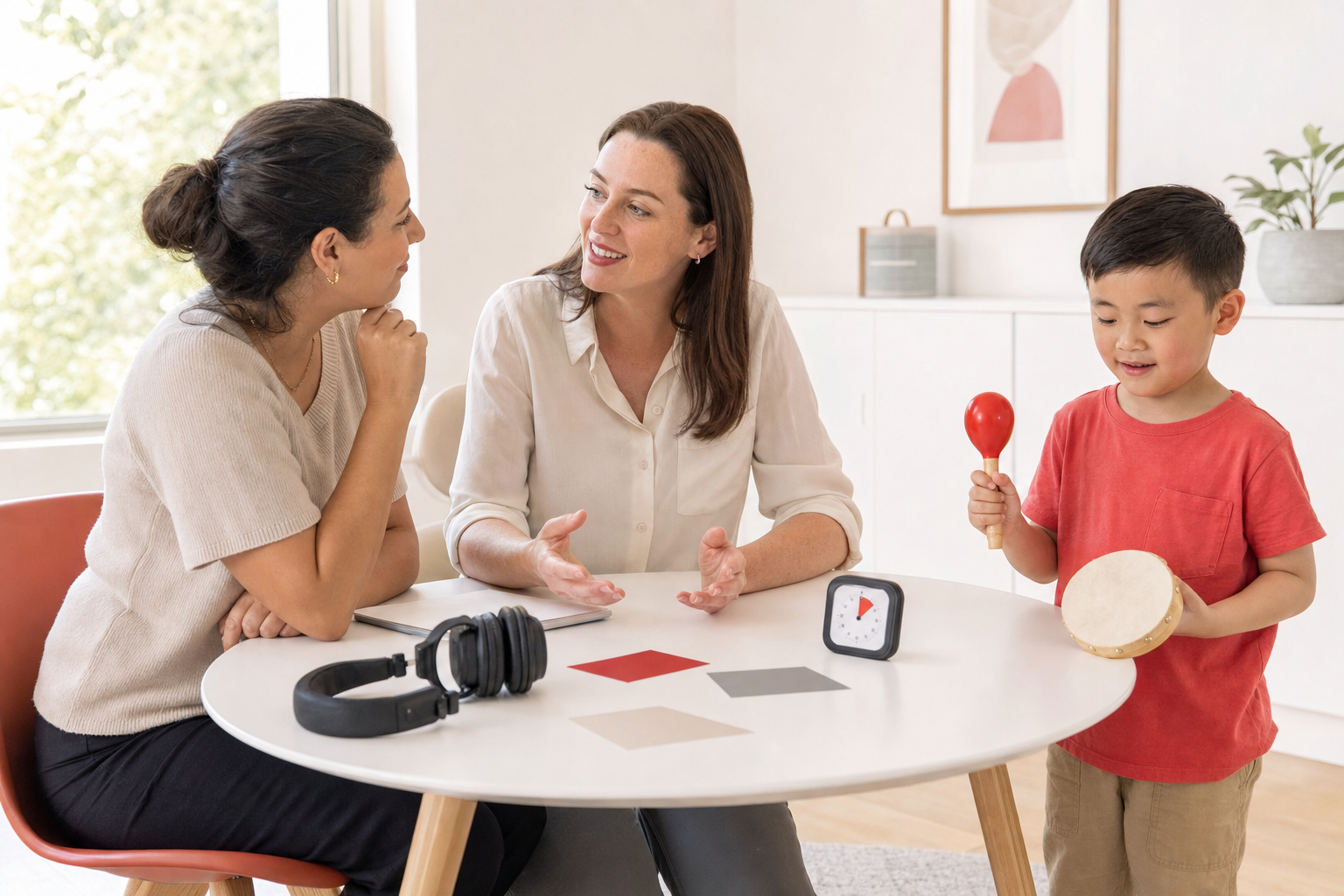
Ask about room noise, lighting, visual distractions, headphones, transitions, waiting areas, and the number of people present. In a group class, ask how keyboards and headphones are used and whether short movement or sensory breaks are possible when reasonable.
No learning space can remove every sound or transition. The goal is to identify practical supports before the child arrives and to know what alternatives are available if the current setup becomes overwhelming.
6. What should practice look like at home?
Practice should be clear enough that the child knows how to begin. Ask the teacher for a small first task, a stopping point, and an option for a lower-energy day. One child may succeed with five focused minutes and a preferred song; another may enjoy a longer sequence with a visible checklist.
If practice becomes a recurring conflict, do not assume the child lacks motivation. The task may be too large, the directions may be unclear, the environment may be uncomfortable, or the music may not feel connected to the child. This guide to helping a child practice piano without becoming the teacher offers a calmer way to reset the routine.
7. How will we review whether the format is working?
Set a review point before enrollment. Ask what progress may look like in the first few lessons: entering the room more comfortably, following one transition, finding a keyboard pattern, keeping a short steady beat, playing part of a song, asking for a break, or beginning practice with less adult help.
Progress should not be measured only by completed pages. Use a short, defined checkpoint to discuss what is working, what needs adjustment, and whether the lesson format still fits. iPianoLab structures levels as six lessons, which can provide a natural early review point; read more about what parents may notice in the first six weeks.
Group, private, or online: which format may fit?
| Format | May be worth exploring when... | Confirm before enrolling |
|---|---|---|
| Group class | Your child enjoys peers, shared routines, and learning through group energy | Class size, noise level, individual guidance, headphones, transitions, and available breaks |
| Private lesson | Your child benefits from individualized pacing, a quieter setting, or frequent teacher adjustments | Teacher experience, parent involvement, lesson length, communication, and accommodation limits |
| Online learning | Home is the most comfortable environment and your child responds well to visual, repeatable instruction | Lesson sequence, keyboard and device setup, adult support, feedback, and progress organization |
No format is automatically best for ADHD, autism, dyslexia, or any other learning difference. Choose from the child’s actual response and the program’s ability to provide reasonable support. If you are comparing formats more broadly, use these 12 questions for choosing piano lessons.
What reasonable support can look like
- Adjusting the pace or breaking a task into smaller steps.
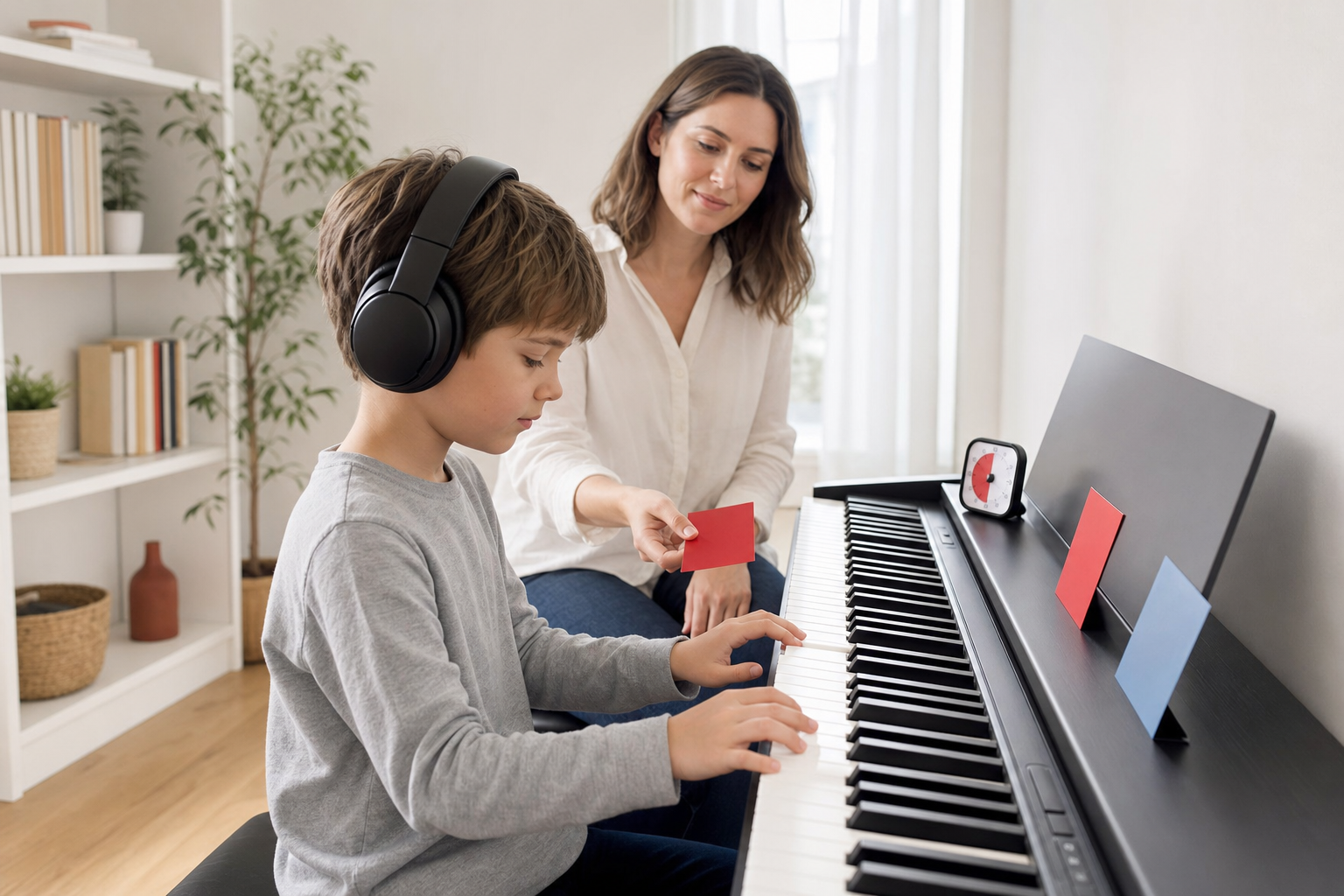
- Using visual schedules, written reminders, color coding, modeling, or simplified directions.
- Allowing extra processing time or a short movement or sensory break.
- Reducing distractions when practical.
- Offering another way to demonstrate learning.
- Adapting practice goals to attention, motor skills, or emotional readiness.
- Using predictable routines, transitions, and strengths-based encouragement.
- Planning reasonable parent or caregiver involvement.
Accommodations are considered case by case. iPianoLab is a music education provider, not a clinical, therapeutic, medical, behavioral, or special education provider. Some requests may be outside the scope or resources of a particular class or lesson. When a requested accommodation is not possible, the policy calls for a good-faith conversation about alternatives.
Frequently asked questions
Are piano lessons good for children with ADHD?
Piano can be a meaningful activity for a child with ADHD when the lesson uses workable pacing, clear directions, engaging music, movement when appropriate, and realistic practice expectations. Fit should be judged from the individual child’s response, not from the diagnosis alone.
Are piano lessons good for autistic children?
Autistic children can learn and enjoy piano. Some may benefit from predictable routines, visual supports, careful sensory planning, extra processing time, or a teacher who communicates in concise steps. Ask about the exact environment and supports before enrolling.
Does my child need a diagnosis to request support?
No formal diagnosis is required to discuss a child’s learning needs or request reasonable support at iPianoLab. Families can share the practical strategies, sensitivities, communication preferences, and goals that help the child participate successfully.
Should a parent stay during the lesson?
It depends on the child, format, safety needs, and what the teacher can reasonably support. A parent or caregiver may be helpful for communication, regulation, or transitions, while another child may focus better with more independence. Use this guide to decide whether a parent should sit in on piano lessons.
What should I tell the teacher before the first lesson?
Share strengths, musical interests, communication preferences, sensory sensitivities, attention supports, useful calming or transition strategies, motor considerations, successful school or home supports, and any safety information the teacher needs. Keep the conversation focused on what helps the child access learning.
Choose a respectful, workable first step
The right piano program should be able to explain its lesson structure, listen to your family, describe reasonable supports, and name its limits honestly. Your child does not need to fit one standard picture of a piano student. The learning path should make musical progress more accessible while preserving dignity, safety, and confidence.
Ready to explore current iPianoLab paths? Review the Inclusive Instruction Policy, then find an iPianoLab signup path, check school-based classes for families, or explore online learning.