Why Does My Child Miss Repeat Signs in Piano Music?
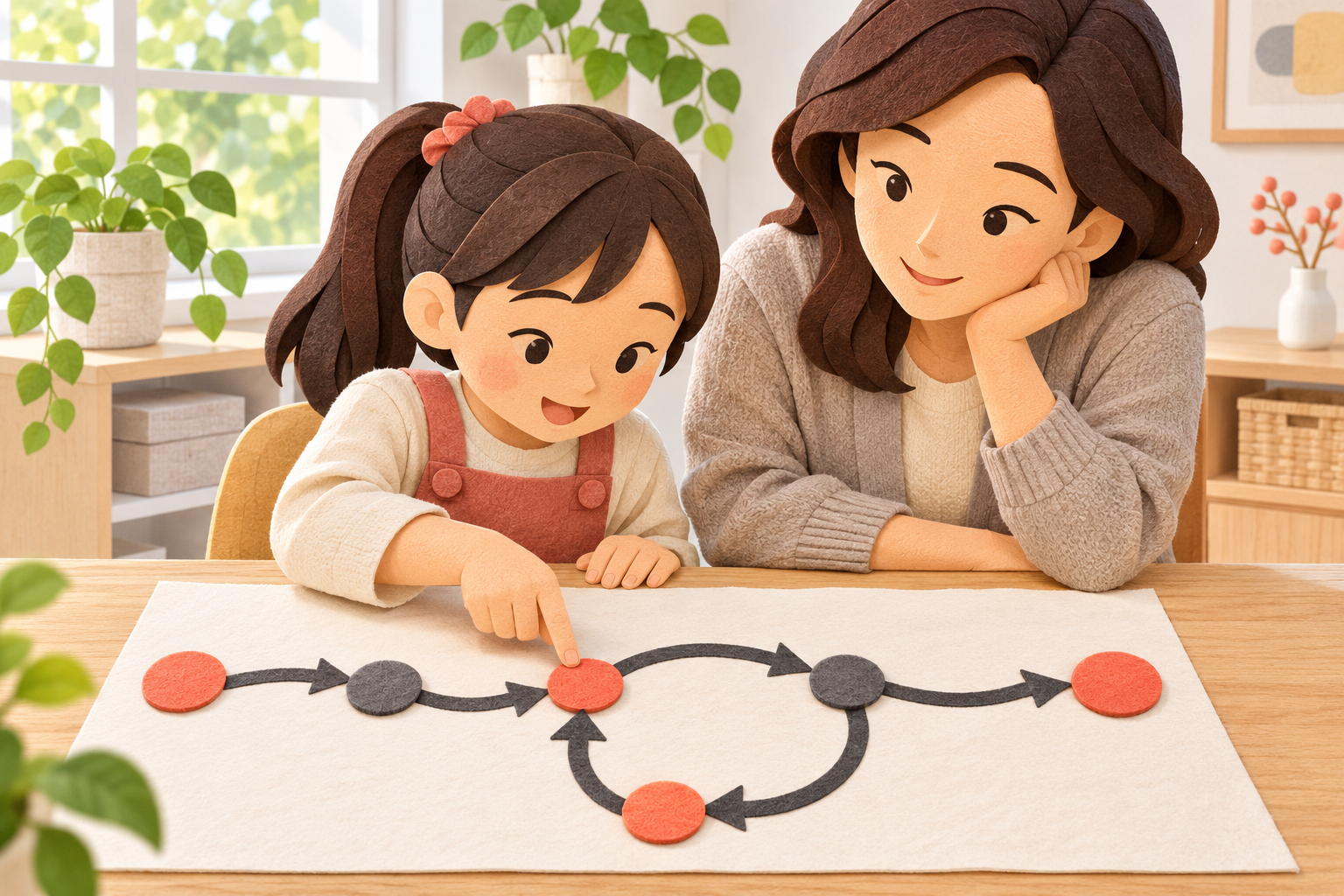
Quick answer: a child may miss a repeat sign because playing already uses attention for notes, rhythm, fingering and hand movement. The repeat symbol changes the route through the page, so the child must read where to go as well as what to play. Before touching the keys, trace the section with a finger, find where the repeat begins and ends, and say the route in simple words.
Why are repeat signs hard for beginner pianists?
A beginner often reads music as one straight path from left to right. Repeat signs ask the eyes to stop at one point, return to an earlier point and then continue. First and second endings add another choice: play one ending the first time, return, then skip it and take the other ending.
That route can disappear once the child starts concentrating on the keys. Missing the sign is not necessarily carelessness. It may mean that page navigation has not yet become part of the playing plan.
What should a parent notice first?
| What happens | Likely reading problem | Useful first check |
|---|---|---|
| The child plays straight past the repeat sign | The end marker was not noticed while attention stayed on notes or fingers | Point to the repeat boundary before playing |
| The child repeats from the beginning of the whole song | The return point is unclear | Find the matching start of the repeated section |
| The child repeats forever or stops after one pass | The number of passes is not part of the plan | Ask the child to say the route before playing |
| The child plays both endings in a row | The first-pass and second-pass choices are not separated | Trace each pass away from the keyboard |
Use the teacher’s marked assignment as the authority. Music can include additional directions, so do not invent a route when the page is unclear.
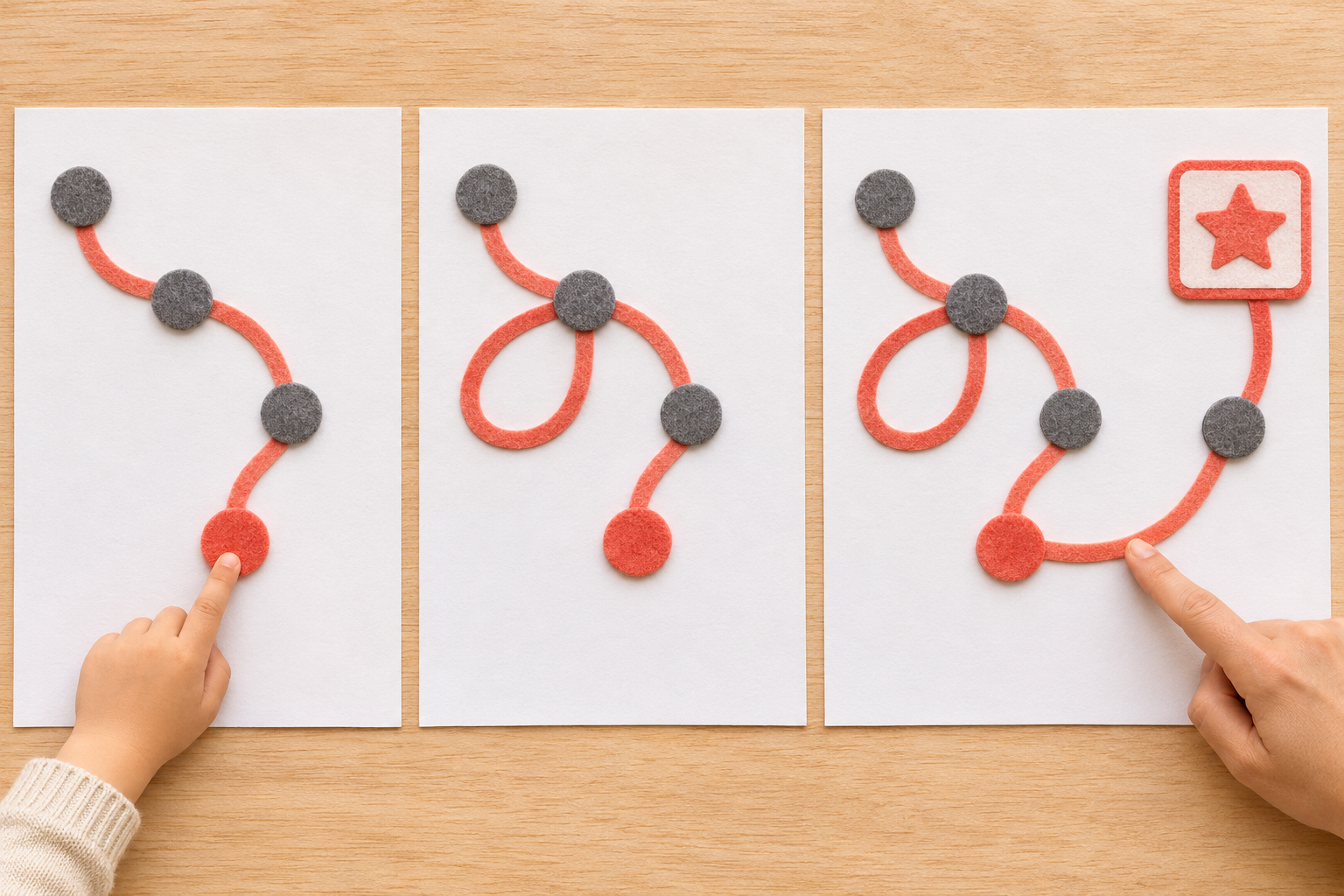
A five-minute find–trace–play routine
Choose one short repeated section from the assigned music. The goal is to learn the route, not to perfect the whole song at the same time.
- Find the finish. Ask the child to point to the end of the repeated section. Do this before counting or playing.
- Find the return. Trace backward to the place where the repeated section begins. If the teacher has marked it, use that exact cue.
- Say the route. Try a short script: “Play to here, go back once, then continue.” For first and second endings: “First time, ending one; go back; second time, ending two.”
- Trace both passes. Move a finger under the music at a steady pace. On the second pass, deliberately skip the first ending when the notation requires it.
- Play one small section. Play the route slowly. Stop after the continuation point, then ask the child to explain where the eyes moved.
If the route works while tracing but disappears at the piano, reduce the musical demand. Try one hand, a slower tempo or fewer measures so the child can coordinate navigation with playing.
How do first and second endings work?
In the common beginner pattern, the first ending belongs to the first pass. At its repeat sign, the player returns to the marked beginning. On the second pass, the player skips the first ending and moves to the second ending.
The important home-practice skill is not memorizing a long definition. It is being able to point to the route for pass one and pass two. If the endings or repeat boundaries are not clear, record the measure number and ask the teacher to demonstrate the path.
Common repeat-sign mix-ups
The child starts the repeat at the beginning of the song
The top of the page is easy to find, so it becomes the default restart point. Ask the child to locate the actual repeat start and practice beginning there twice without playing the entire song. This builds the same visual-location skill used in the guide to finding a lost place in piano music.
The child keeps repeating the section
Make the number of passes concrete. Trace the first pass and second pass separately, then stop at the continuation point. Avoid adding many marks to the page unless the teacher recommends them.
The child plays the first and second endings consecutively
Practice the route away from the keys. On pass one, trace into the first ending and return. On pass two, trace past the first-ending branch and into the second. The hands do not need to solve the notes while the eyes learn this path.
The child knows the route but loses the beat
Page navigation and steady rhythm are separate skills that must eventually work together. First make the route reliable; then tap or count through the repeat without an extra pause. If every bar line causes a stop, use the last-beat–first-beat bridge routine.
What can a parent say without becoming the teacher?
- “Show me where this section finishes.”
- “Where do your eyes return?”
- “How many times do you travel through this section?”
- “Which ending belongs to the first pass?”
- “Trace the route before you play it.”
- “Let’s write down the exact spot that needs teacher help.”
Avoid “You missed the dots again” or “Just start over.” Those comments identify the error without giving the child a way to map the page.
When should you ask the piano teacher?
Ask when the child cannot identify the repeat start, the printed route has extra directions, the endings remain unclear, or tracing works but playing does not improve after a few calm attempts. Bring one specific question: “Should my child return to this measure, and which ending should we take on each pass?”
If the larger problem is returning to the right line after looking at the hands, use the guide to losing place in piano music. If a mistake always sends the child back to the opening, the guide to starting over after every mistake teaches flexible restart points.
Frequently asked questions
Does every repeat sign mean play the music twice?
A simple repeat commonly means play the marked section again, but other directions can change the route or number of repetitions. Follow the printed music and the teacher’s instructions for the specific piece.
Should I circle repeat signs in my child’s music?
Only if the teacher agrees. One temporary visual cue may help, but too many marks can add clutter. The lasting skill is learning to find both ends of the repeated section.
Why can my child explain the repeat but still miss it while playing?
Explaining and coordinating are different tasks. Notes, rhythm and movement may use all of the child’s attention. Make the section smaller and slower until the route stays visible during playing.
Is a repeat sign the same as starting over after a mistake?
No. A repeat sign is part of the intended musical route. Restarting after a mistake is a practice habit. Teach the written repeat deliberately and practice mistake recovery separately.
Turn the page into a route
Repeat signs become easier when a child stops treating the page as one straight line. Find the boundary, locate the return, trace each pass and then play a small section. That simple map gives the eyes a job before the hands begin.
Looking for a beginner piano path with clear weekly steps? Find an iPianoLab school class.
Find an iPianoLab School Class